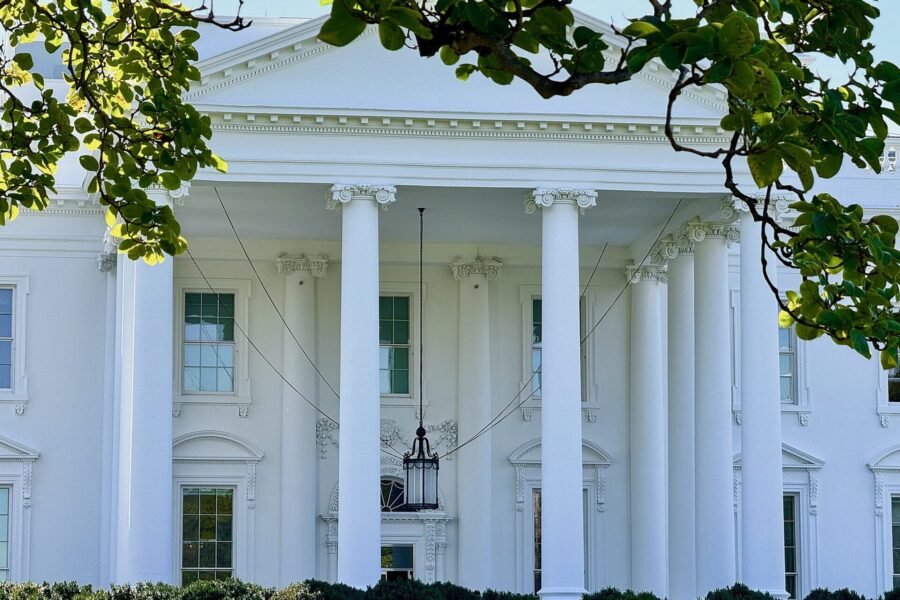
Seeing the State in Motion
Government is not a single building but a moving system of tiers, departments and languages. One issue has many owners and many voices, and a state that reads only its dominant language sees only part of itself.

Type “Punjab floods” into a search box and you will be shown two places. One is a state in north-west India; the other is a province in eastern Pakistan. They share a name, a river system, a language with two scripts, and a monsoon. They do not share a government, a disaster agency, a budget or a minister. A monitoring system that cannot tell them apart will merge two emergencies into one, credit one government with another’s response, and send a briefing to the wrong desk. The same trap waits elsewhere: Georgia the country and Georgia the American state; Macedonia the Greek region and North Macedonia the republic; Luxembourg the Grand Duchy and Luxembourg the Belgian province.
It is a small example of a large truth. Government is not a single object to be watched. It is a moving system: layered across national, regional and local tiers, divided among departments, spoken in many languages, and constantly changing over time. An issue does not sit still in one place. It moves between owners, between channels and between languages. To see it clearly, a decision-maker has to see it in motion.
One issue, many owners
Federal and multi-tier states make this obvious, but every large government faces it to some degree.
In the United States, the governance of artificial intelligence is now being settled less in Washington than in the states and the courts. An executive order in December 2025 created a Justice Department task force to challenge state AI laws and linked federal broadband funding to them. A House discussion draft that would pre-empt state rules on model development for three years has not been formally introduced. Meanwhile California’s governor signed 13 AI bills in his final decisions of 2026, including the “No Robo Bosses Act”, which bars employers from firing or disciplining workers on automated output alone. Colorado, under federal and industry pressure, went the other way, repealing its broader AI law in May 2026 and replacing it with a narrower transparency statute. On election deepfakes, the National Conference of State Legislatures counts 31 states with disclosure or deepfake laws, while the Federal Election Commission has deadlocked. Ask “what is America’s policy on AI?” and the only honest answer is: which tier, which state, and on which day?
The European Union is a different structure with the same property. Its AI Act is a single regulation, but implementation runs through 27 member states, each with its own authorities, languages, administrative traditions and timetables. The omnibus that took effect on 27 July 2026 pushed national regulatory sandboxes back to August 2027. Whether a public body in one member state is ready for the high-risk obligations, now due from 2 December 2027, will depend heavily on national capacity, and that varies.
India’s states hold significant powers over policing, health and much of public order, and its national IT Rules, amended in February 2026, now require AI-generated content to be labelled and takedown orders to be complied with within three hours. The United Kingdom has devolved governments in Scotland, Wales and Northern Ireland that run their own health, education and, in some cases, justice systems. Pakistan divides responsibilities between federal and provincial governments and runs its public life in Urdu and English alongside Punjabi, Sindhi, Pashto, Balochi and other languages.
In each case a single issue, such as a contested algorithm in benefits, a deepfake in a campaign or a flood, will have a national face, a regional face and a local face. Each tier sees a different part of the problem, has different powers to act, and is answerable to a different public. A briefing that presents the issue from one tier alone is not wrong, but it is incomplete in a way that can mislead.
How issues travel
Issues also move in time and across channels, and they tend to follow a recognisable path.
Something happens to someone. They tell others, increasingly in a post, a voice note or a short video. A local journalist or a community organisation notices a pattern. A regional outlet runs it. A national outlet picks it up, often weeks later and in a different language. A legislator asks a question. A department is asked for a line. Only then, in many cases, does the issue enter the policy process.
Each step changes the issue. Details drop out. Framing sharpens. The question that began as “why was my claim refused?” becomes “is the algorithm biased?” and then “should the programme be scrapped?” By the time the issue reaches a minister, it may be framed in a way that bears little resemblance to its origins, and the options for a measured response have narrowed.
A government that watches only the last steps of this path, the national press and parliamentary questions, will always be late. A government that can see the earlier steps has a chance to respond while the issue is still small, specific and solvable. The technical challenge is that the earlier steps often happen in different channels, in different formats and, crucially, in different languages.
The language problem
Continue reading, free.
Create a free AI & GPP account to finish this Long Read and every other one — plus The Cable in your inbox.
Discussion
No comments yet. Start the conversation.