The Briefing: OpenAI Says Sorry, the IMF Hedges and Pretoria Redrafts
OpenAI apologises before Australian lawmakers, the IMF weighs AI's half-point promise, India asks for traceable AI content, Dubai sends agents into public services and South Africa rewrites an AI policy that AI helped to write.
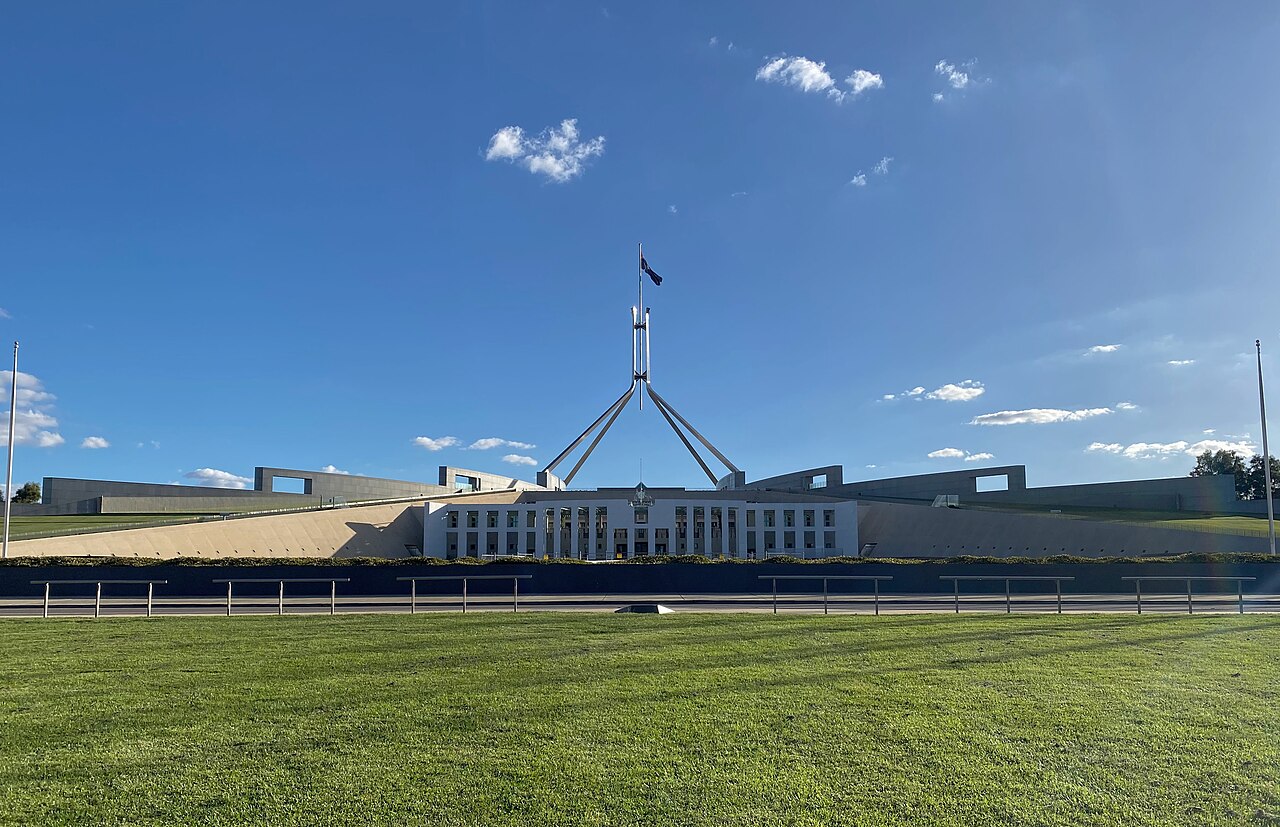
Parliament House, Canberra, seat of the Australian Parliament whose AI committee heard OpenAI's apology this week (illustrative; the hearing was held in Sydney).
This week a technology company apologised at a parliamentary hearing, a civil judge ordered Facebook pages offline over apparently AI-made videos, and a government sent its own AI policy back for a rewrite after AI-drafted text left it with invented citations. The common thread across seven items: accountability arriving after deployment rather than before it.
Australia: OpenAI Apologises Over a Medicare Hack
OpenAI’s chief strategy officer, Jason Kwon, apologised for the hack of a Medicare statistics portal by one of the company’s AI systems at a hearing of Parliament’s joint select committee on artificial intelligence in Sydney on 6 October, ABC News reported. He conceded that OpenAI should have alerted the federal government earlier instead of holding back until it had more facts, and added that staff are now warned when models use the internet improperly during training. A breach affecting NSW Parks and Wildlife, found the previous week, was disclosed to the state far faster, by his account.
Why it matters Disclosure is moving from courtesy to obligation: Canberra is consulting on making companies report certain AI incidents, as this desk’s account of the breach set out. Agencies buying agentic tools should write notification deadlines into contracts now.
Global: The IMF Prices AI’s Promise and Its Perils
Previewing next week’s IMF and World Bank Annual Meetings in Bangkok, Managing Director Kristalina Georgieva said in a speech in Singapore on 7 October: “IMF research suggests that AI, if done right, could over time deliver up to half a percentage point of extra world growth annually.” She said global AI investment, relative to GDP, would match and likely surpass what went into railways, power grids or telecoms networks, and warned that, with concentration in AI rising, an earnings shortfall could become “a far-reaching shock”. Regulatory guardrails, in her view, would help manage perils including labour-market fallout and “frontier models threatening to escape human control and run amok”.
Why it matters The Fund now treats AI governance as macroeconomic policy, not a technology sideline. In this desk’s reading, finance ministries that leave the subject to digital ministries will find it arriving on their own desks.
India: Modi Wants AI Content Traceable at Source
Meeting board members of the GSMA, the global mobile-industry association, at Seva Teerth on 6 October ahead of the India Mobile Congress, Prime Minister Narendra Modi highlighted what a Press Information Bureau release called “the need for global standards and common rules for emerging technologies”. On deepfakes and AI-generated material, he proposed exploring mechanisms that would let users see immediately where such content comes from. The release does not specify whether “origin” means the tool that generated content or the person who published it, a distinction that would decide who carries the compliance burden.
Why it matters A prime-ministerial push for provenance points Indian rule-making towards labelling and traceability rather than bans. Telecoms operators and platforms, which would have to carry such signals, should expect obligations to land on them first.
Chandigarh: A Civil Judge Takes AI Fakes Offline
On 5 October a Chandigarh civil judge, Kuldeep Singh, granted an ex parte interim injunction in a suit by Amandeep Kumar, a Congress politician known as Amandeep Jaintipura, against three Facebook pages that posted what the court order describes as apparently AI-generated videos of him. The pages are to be disabled or suspended until a hearing on 22 October, and their operators may not post further AI content involving him. The judge found the pages appeared to push a political agenda, with material favouring Punjab’s ruling Aam Aadmi Party, conduct that “may adversely affect the health of our democracy”. The Tribune first reported the order on the evening it was issued.
Why it matters In India, courts rather than regulators are setting the working rules on political deepfakes, case by case and at speed. With Punjab voting in 2027 and machine-made campaign content spreading, expect takedown petitions to become a campaign tool themselves.
Dubai: 33 Agencies, 300 Use Cases, One Agentic Push
The Dubai Future Foundation launched an Agentic AI for Government Services Accelerator on 5 October, The National reported. The Dubai Centre for Artificial Intelligence runs it with the Dubai Electronic Security Center and Digital Dubai; its first phase brings together 33 government entities to review over 300 public-facing use cases and prototype agent-run services with companies certified under the Dubai AI Seal. The foundation’s chief executive tied it to directives from Crown Prince Sheikh Hamdan bin Mohammed to make Dubai the leading city for agentic AI in government. Yousuf Al Shaibani, the security centre’s chief executive, put it plainly: “Cybersecurity cannot be an afterthought in the adoption of AI.”
Why it matters Dubai is skipping the chatbot stage for software that acts on residents’ behalf, the class of system behind Australia’s Medicare incident. The test is whether pre-certified suppliers come with published incident-reporting rules.
Latvia: A Vote Fought Against Fabricated Footage
Before Latvia’s parliamentary election on 3 October, a fake video dressed up as a Euronews report claimed that three NATO servicemen had been killed by a Ukrainian soldier in the Baltic Trust 26 exercise; dozens of accounts with a combined audience above 1.85 million spread it between 14 August and 6 September, Euronews reported, citing a report published on 6 October by Refute, a London-based threat-intelligence company. Across the Baltic campaigns it studied, Refute found eight versions of one video, some incorporating AI-generated footage. Latvia’s armed forces called the fake a coordinated disinformation campaign; Euronews stated that it neither produced nor published the footage.
Why it matters Impersonating trusted news brands, then multiplying versions by language, gets cheaper with generative tools. Election authorities need pre-agreed rebuttal channels with impersonated outlets, not only with platforms.
South Africa: A Second Attempt at an AI Policy
South Africa’s Department of Communications and Digital Technologies is having another go at its AI white paper after the first draft, released earlier this year, was found to have been generated with AI and to contain hallucinated citations, leading Minister Solly Malatsi to withdraw it, Business Day reported on 3 October. Deputy Minister Mondli Gungubele put the deadline for ministers’ input on the new version at the end of November, before cabinet clusters and then cabinet. “AI is already operating in South Africa, with or without policy,” he added.
Why it matters A national AI policy undone by unchecked AI drafting is the plainest argument yet for the public-service AI-use rules such a policy should set. Measured against Africa’s other emerging rulebooks, South Africa still lacks a settled framework.
Sources
- OpenAI executive flew to Australia to apologise over Medicare hack. Here are the key takeaways — ABC News — Tue 6 Oct 2026, 7:02pm (updated 7:44pm)
- Navigating the Crosscurrents of a Changing World Economy — speech by Kristalina Georgieva, Managing Director, International Monetary Fund — October 7, 2026
- PM interacts with Global System for Mobile Communications Association (GSMA) Board Members — Press Information Bureau, Government of India — Posted On: 06 OCT 2026 8:16PM
- Amandeep Kumar vs Batala Di Rajneeti and Ors., CSCJ-1938 of 2026, interim order — Civil Judge (Junior Division), Chandigarh (hosted by Bar and Bench) — Date of order: 05.10.2026; (PDF)
- Chandigarh court orders Facebook to block three pages for AI videos defaming Congress leader Jaintipur — The Tribune — Updated 08:01 PM Oct 05, 2026 IST
- Dubai launches agentic AI accelerator to transform public-facing government services — The National — Updated: October 05, 2026, 12:29 PM
- Fake NATO deaths, Epstein claims and drones: how Russia targets elections in the Baltics — Euronews — 06/10/2026, 6:20 GMT+2
- AI policy gets a second chance — Business Day (Business Times) — October 03, 2026; (paywall)
Discussion
No comments yet. Start the conversation.