163 to 5: New York Backs Talks on Autonomous Weapons
The UN First Committee has cleared all four military-AI texts: 163 to 5 for 'advance to negotiations' on autonomous weapons, 171 to 4 for two years of Geneva dialogues, a consensus CCW omnibus. What the counts settle before the Review Conference, and what they cannot.
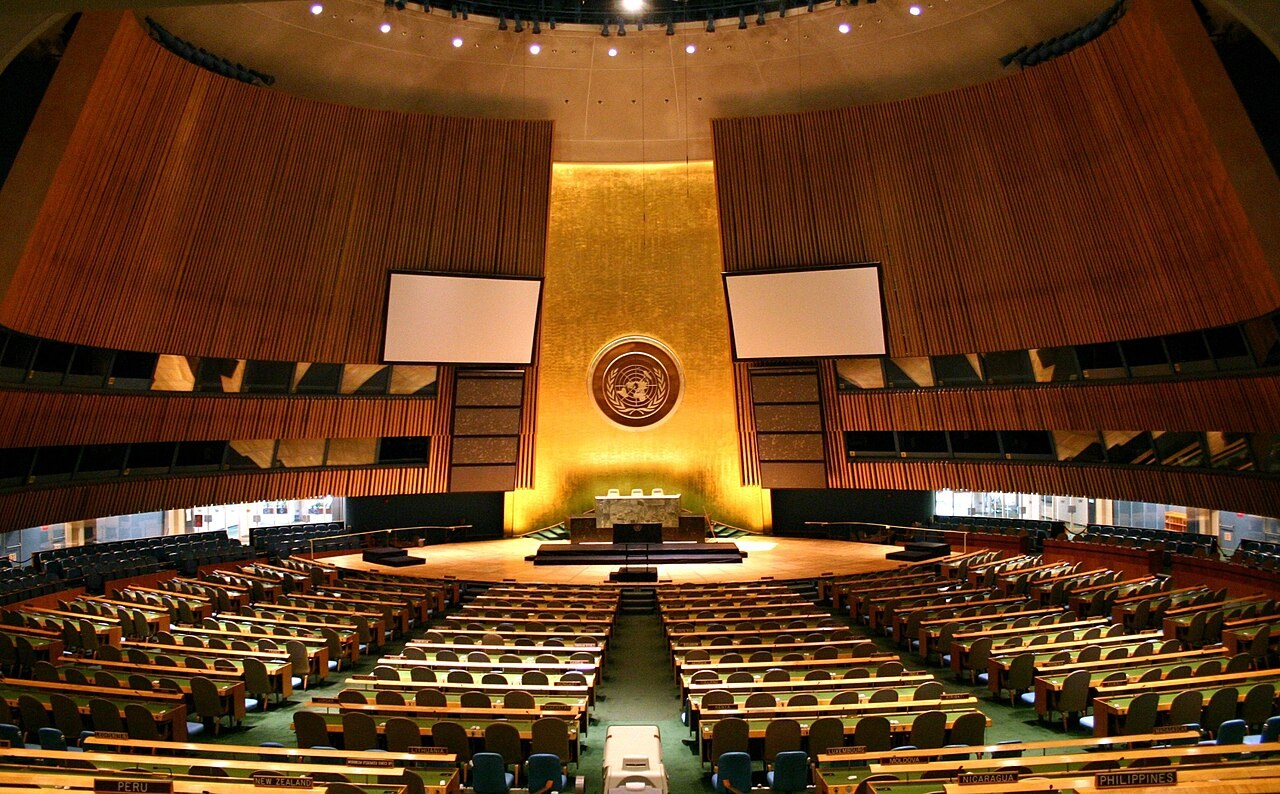
Between 27 and 30 October 2026, the General Assembly’s First Committee cleared all four texts on military artificial intelligence before it. The headline number is 163 to 5: the vote on 29 October for draft resolution A/C.1/81/L.37, which calls on parties to the Convention on Certain Conventional Weapons (CCW) to “advance to negotiations” on lethal autonomous weapons systems. A day later 171 states backed L.34, which books two years of structured dialogues on military AI in Geneva. The CCW omnibus, L.67, passed without a vote; Mexico’s nuclear-command decision went through on 27 October. The counts matter because the CCW’s Seventh Review Conference opens in Geneva on 16 November.
What each text does, and how it got through
| Draft | Subject | Committee action | Count | Against |
|---|---|---|---|---|
| A/C.1/81/L.37 | Lethal autonomous weapons systems | 29 October, recorded vote | 163–5–9 | Belarus, DPRK, Israel, Russia, United States |
| A/C.1/81/L.34 | AI in the military domain | 30 October, recorded vote | 171–4–6 | DPRK, Israel, Russia, United States |
| A/C.1/81/L.67 | CCW omnibus (Uganda) | 29 October, without a vote | — | — |
| A/C.1/81/L.21 | AI in nuclear command, control and communications (decision) | 27 October, vote type not stated | — | — |
Source: UN Meetings Coverage summaries GA/DIS/3778, 3781 and 3782; draft texts on the UN Digital Library. Counts are in favour, against, abstaining.
The UN summary of the 29 October meeting (GA/DIS/3781) records the L.37 vote and nine abstentions: Argentina, Burundi, China, Congo, Iran, Nicaragua, Poland, Saudi Arabia and Türkiye. The summary of 30 October (GA/DIS/3782) gives L.34’s count, with Argentina, Belarus, Iran, Nicaragua, Saudi Arabia and South Sudan abstaining. The summary of 27 October (GA/DIS/3778) lists L.21 among three decisions approved that day without saying whether a vote was taken. All three are marked “not an official record”.
What “advance to negotiations” adds to last year’s wording
The operative shift is in L.37’s third paragraph. The draft text, tabled on 13 October by 21 states, calls on CCW parties “to advance to negotiations on an instrument on lethal autonomous weapons systems, building upon the set of elements” agreed by the Group of Governmental Experts (GGE). Last December’s resolution, as the General Assembly’s summary of the 1 December 2025 plenary records, asked parties only to work towards completing those elements “with a view to future negotiations”.
The count barely moved: 164 to 6 with seven abstentions in the 2025 plenary, 163 to 5 with nine in committee this year. Burundi, against in December, abstained; Congo is a new abstention; the other no votes and abstainers are unchanged. Stop Killer Robots reported on 30 October that the text had 34 co-sponsors, a figure no revised UN document yet confirms.
L.34 is the broader text. Its 47 sponsors include France, Germany, the United Kingdom, Pakistan and Nigeria. It welcomes the UNIDIR Centre of Excellence on AI, Peace and Security, and decides on one three-day informal meeting in Geneva in each of 2027 and 2028. Against the December vote of 167 to 5, Burundi left the no column and South Sudan is a new abstention; the other names are unchanged. The forum was examined in Geneva Gets a Standing Forum on Military AI.
Why the consensus text matters as much as the vote
The omnibus is where the Review Conference’s procedural leash is written. Uganda’s draft welcomes the GGE’s “significant and substantive final report” and, in its eighth paragraph, calls on CCW parties “to consider and endorse the conclusions of the final report” and “to decide by consensus on the possible modalities of the future work of the Group”. It also recalls the decision to hold the Review Conference from 16 to 20 November.
A vote of 163 to 5 in New York cannot write a mandate in Geneva, where a single objector can hold the pen.
That is the tension set out in Consensus or Exit: Five Weeks to Decide on Autonomous Weapons. No delegation asked for a vote on L.67’s “by consensus” wording.
The pro-mandate coalition put its own number on record a week earlier. A joint statement delivered by Ireland on 22 October, published by New Zealand’s foreign ministry, calls the GGE’s elements “a solid and sufficient basis” for a GGE negotiating mandate and says its signatories stand ready to agree “an ambitious negotiating mandate on Lethal Autonomous Weapons Systems this November”. The published text names 50 states; Stop Killer Robots and Reaching Critical Will both put the number at 52, which may reflect later endorsements.
What is still pending
L.21 does nothing but keep the “possible risks of the integration of artificial intelligence into command, control and communications systems of nuclear weapons” on next year’s agenda. The resolution it recalls, 80/23, passed the plenary last December by 118 to 9, with France, the United Kingdom and the United States among those against.
The summaries record no explanations of vote on any of the four texts. Plenary adoption, which last year came on 1 December, is still to come. The question the votes cannot answer, whether a negotiating mandate survives a consensus rule, falls to Geneva from 16 November. Ministries that buy or build autonomous systems should read L.37’s third paragraph and L.67’s eighth together: one is the political demand, the other the procedure that can stop it.
Sources
- First Committee Forwards 14 Texts on Outer Space, Conventional Weapons to General Assembly (GA/DIS/3781) — UN Meetings Coverage and Press Releases, 29 October 2026
- First Committee Recommends 13 Texts on Other Disarmament Measures, International Security for General Assembly Action (GA/DIS/3782) — UN Meetings Coverage and Press Releases, 30 October 2026
- First Committee Advances Broad Package of Nuclear Disarmament Texts (GA/DIS/3778) — UN Meetings Coverage and Press Releases, 27 October 2026
- A/C.1/81/L.37, Lethal autonomous weapons systems: draft resolution — UN Digital Library, 13 October 2026 (PDF)
- A/C.1/81/L.34, Artificial intelligence in the military domain and its implications for international peace and security: draft resolution — UN Digital Library, 13 October 2026 (PDF)
- A/C.1/81/L.21, Possible risks of the integration of artificial intelligence into command, control and communications systems of nuclear weapons: draft decision — UN Digital Library, 12 October 2026 (PDF)
- A/C.1/81/L.67, Convention on Prohibitions or Restrictions on the Use of Certain Conventional Weapons: draft resolution — UN Digital Library, 16 October 2026 (PDF)
- General Assembly Adopts More Than 60 Resolutions, Decisions of Its First Committee (GA/12736) — UN Meetings Coverage and Press Releases, 1 December 2025
- United Nations General Assembly First Committee 2026: Cluster 4 Joint Statement on Lethal Autonomous Weapon Systems — New Zealand Ministry of Foreign Affairs and Trade, 22 October 2026
- 163 states support UNGA resolution on autonomous weapons — Stop Killer Robots, 30 October 2026
- First Committee Monitor, Vol. 24, No. 4: Advancing Disarmament in Challenging Times — Reaching Critical Will, 25 October 2026
Discussion
No comments yet. Start the conversation.