Consensus or Exit: Five Weeks to Decide on Autonomous Weapons
Geneva experts have finished their draft elements on lethal autonomous weapons. On 16 November, the CCW Review Conference decides by consensus whether to open treaty talks, and a handful of militaries can still say no.
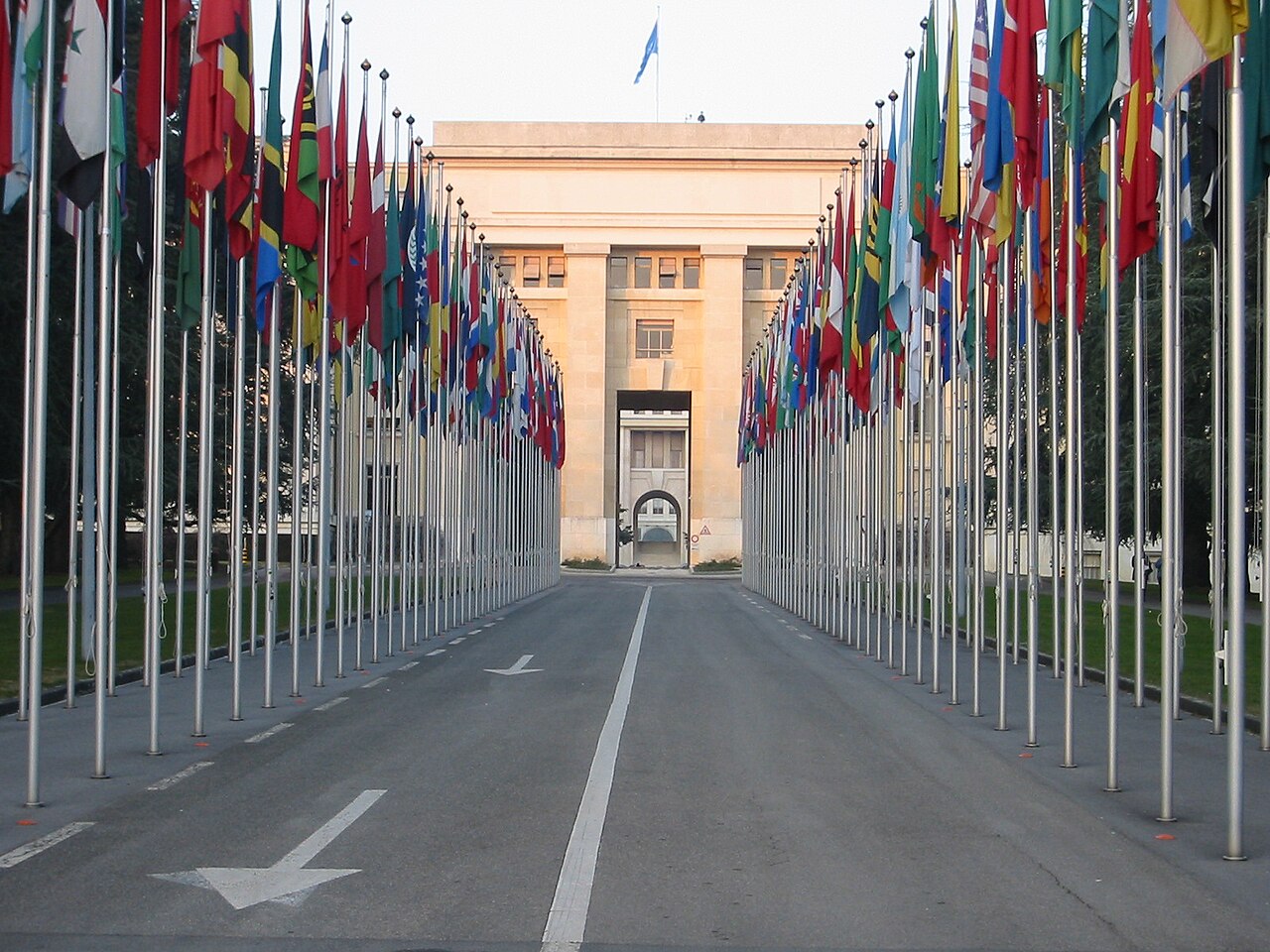
Flags in front of the Palais des Nations, Geneva, where the CCW Review Conference meets.
Photo: Yann Forget (Commons user Yann), CC BY-SA 3.0 · source
Three years of expert talks on lethal autonomous weapons ended in the early hours of 5 September 2026, when the Group of Governmental Experts (GGE) of the Convention on Certain Conventional Weapons (CCW) adopted its final report, by advocacy groups’ accounts. The Seventh Review Conference of the CCW, which the parties scheduled for 16 to 20 November 2026 in their 2025 meeting report, must now decide whether those elements become the basis for negotiating a binding instrument. It can grant a negotiating mandate, not a treaty, and CCW bodies decide by consensus, so one state party can withhold it.
What the Experts Agreed, and What Was Taken Out
The GGE’s text grew from a “rolling text” kept by its chair, Ambassador Robert in den Bosch of the Netherlands. In a briefing reported by UNODA, given on 23 October 2025, he described it as covering a working characterisation of these weapons, how international humanitarian law applies, prohibitions and restrictions, accountability, and risk mitigation. That structure mirrors the two-tier approach (outright prohibitions for some systems, regulation for the rest) that the UN Secretary-General has called for, as the preamble of General Assembly resolution 80/57 records.
In Hassan Khoder’s Opinio Juris analysis, the chair’s rolling text would ban systems whose “effects in attack cannot be anticipated and limited” and sets “context-appropriate human judgement and control” as the governing standard, which he argues is a looser, more relative test than “meaningful human control”.
The final week narrowed the text. Human Rights Watch says that some states, among them Russia and the United States, insisted on changes that removed references to design and development, to ethical considerations and to predictability, reliability, explainability and traceability, and narrowed the scope from all international law to international humanitarian law alone. Stop Killer Robots, the campaign coalition, says the adopted report still keeps a working characterisation, core measures for human control and the principle that responsibility cannot be transferred to machines. Both are advocacy groups; the campaign noted the report was not yet published.
The Timeline, From Appeal to Deadline
The timeline below is built mainly from UN documents.
| Date | Event |
|---|---|
| 5 Oct 2023 | UN Secretary-General and ICRC President call for negotiations concluded by 2026 |
| 12–14 Nov 2025 | CCW parties’ annual meeting sets 2026 sessions and Review Conference dates |
| 1 Dec 2025 | General Assembly adopts resolution 80/57, 164–6–7 |
| 31 Aug–4 Sep 2026 | Final GGE session; report adopted early on 5 September |
| 7–9 Sep 2026 | Review Conference preparatory committee |
| 16–20 Nov 2026 | Seventh Review Conference decides on a mandate |
The 2023 joint appeal by António Guterres and ICRC President Mirjana Spoljaric asked leaders to conclude negotiations on prohibitions and restrictions by 2026. At most, a mandate will meet that date.
Who Is For, Who Is Against
Resolution 80/57, adopted on 1 December 2025, calls on CCW parties to complete the elements “with a view to future negotiations”. The UN’s record of the plenary shows 164 votes in favour and six against: Belarus, Burundi, North Korea, Israel, Russia and the United States. Argentina, China, Iran, Nicaragua, Poland, Saudi Arabia and Türkiye abstained. Khoder notes that Washington had voted for resolutions 78/241 and 79/62, and he reads its reversal as a response to the rolling text’s human-control wording.
On the other side, Human Rights Watch counts 76 states backing a move to negotiations and, citing Stop Killer Robots, says 70 of them are CCW parties. The campaign’s own August paper said over 70, 66 of them parties. In Geneva, the campaign reports, Algeria for the African Group and Brazil for 47 states backed negotiating.
The Routes Outside the Consensus Rule
If consensus fails, the campaign’s August 2026 paper points to Article 8 of the Convention: a state proposes a protocol in writing and, if a majority of parties agree, a negotiating conference is convened. Human Rights Watch has set out two further options: a stand-alone process modelled on the landmine and cluster-munitions bans, or a General Assembly mandate like the one that produced the nuclear weapons ban treaty. In this desk’s reading, each route trades the major militaries’ participation for a quicker text.
A mandate that the main users of these weapons block yields no treaty; a treaty they never join barely binds them.
What Decision-Makers Should Watch
Defence and foreign ministries must choose between spending capital on a CCW mandate and preparing an exit. That choice sits inside the wider split this magazine traced in Two Blocs, One Technology. Human-control language is not abstract: The Ship That Wasn’t showed how operators come to defer to machine outputs. Before 16 November, watch for the publication of the GGE report, the US and Russian positions at the General Assembly’s First Committee, and whether any state takes up the campaign’s Article 8 route.
Sources
- UN Talks on Killer Robots End with Calls for Negotiations Growing — Human Rights Watch — 7 September 2026; advocacy organisation
- Nothing less than negotiations — Stop Killer Robots — 8 September 2026; advocacy coalition
- The Western Consensus That Was Not: Resolution 80/57, the Rolling Text’s Human Control Substitution, and the Structural Stakes of the November 2026 CCW Review Conference — Opinio Juris — 27 August 2026
- Briefing by the Chair of the CCW GGE on LAWS on the margins of the First Committee — UNODA — 15 December 2025 (briefing held 23 October 2025)
- Final report, 2025 Meeting of the High Contracting Parties to the CCW (CCW/MSP/2025/CRP.1) — UNODA — 12 November 2025; (PDF)
- Resolution 80/57, Lethal autonomous weapons systems (A/RES/80/57) — United Nations General Assembly — adopted 1 December 2025, issued 5 December 2025; (PDF)
- General Assembly Adopts More Than 60 Resolutions, Decisions of Its First Committee (GA/12736) — UN Meetings Coverage and Press Releases — Eightieth Session, 52nd Meeting (AM) (no date on page; meeting held 1 December 2025 per A/RES/80/57)
- Joint call by the United Nations Secretary-General and the President of the ICRC on autonomous weapons systems — ICRC — 5 October 2023
- Killer Robots: Negotiate Treaty in New Forum — Human Rights Watch — 10 November 2022; advocacy organisation
- Launching negotiations in 2026 (advocacy briefing) — Stop Killer Robots — August 2026; (PDF); advocacy coalition
Discussion
No comments yet. Start the conversation.