Fourteen Gigawatts, Three Meanings: Reading Gulf Compute Claims
Saudi Arabia's 14GW AI figure means a site power allocation to one official, national computing ambition to another and something Humain's own roadmap never reaches. Read beside Qatar and the UAE, the Gulf's gigawatt claims need translating before anyone prices them.
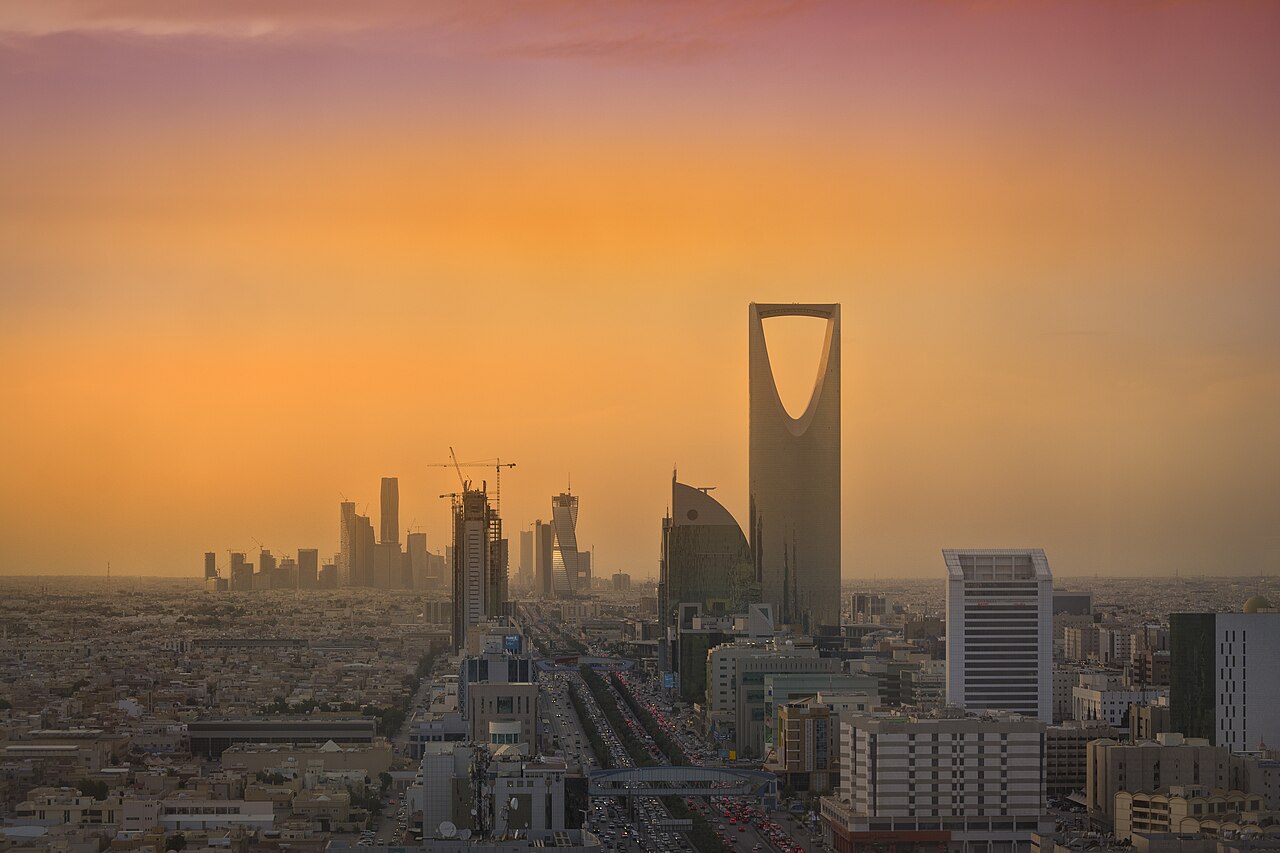
Riyadh's skyline with the King Abdullah Financial District and Kingdom Tower (illustrative).
Photo: B.alotaby, CC BY-SA 4.0 · source
Key points
- In September 2026 Saudi Arabia’s “14GW” was described both as power allocated to one Humain site and as national computing capacity to be built with private partners, while Humain’s own targets stop at about 6GW by 2034, with 2030 put at 1.9GW in one report and about 3GW in another.
- Saudi Arabia’s installed data-centre capacity stood at 467MW in early 2026, according to official data cited by Fortune, so 14GW is roughly 30 times what is running today.
- Qatar’s sovereign route is measured in megawatts: QIA-owned Qai is placing GPUs with MEEZA, which had 14MW of IT capacity in March 2025, according to Gulf Times, and plans to pass 60MW.
Within three weeks in September 2026, Saudi Arabia’s AI build-out acquired three different sizes. A minister spoke of more than 14 gigawatts of computing capacity; the chief executive of Humain, the Public Investment Fund’s AI company, put about 14GW of power on one site; and Humain’s own roadmap stops at about 6GW in 2034, with two different figures for 2030. The figures do not reconcile, and that matters: Humain is courting outside money as the World Bank forecasts a Gulf contraction, and other governments benchmark against Riyadh’s headline. This analysis sets the Saudi numbers beside Qatar’s and the UAE’s, in a table built from each project’s own statements, and explains what each measures.
Three Saudi Numbers That Measure Different Things
The largest claim came from Abdullah Alswaha, Minister of Communications and Information Technology. In a keynote at the Frontier Leaders Forum 2026 in Silicon Valley, he said the kingdom is partnering with the private sector to develop over 14GW of computing capacity, the Saudi Press Agency reported on 11 September. No date, site or public-private split was attached. The unit is power, but the noun is “computing capacity”: an economy-wide ambition, not a project.
By the end of the month the number had returned with another meaning. At a business forum in Riyadh, Humain’s chief executive, Tareq Amin, said roughly 14GW of power had been set aside for the site where the company is building “AI factories”, Asharq Al-Awsat reported on 30 September. The report named no allocating body, saying only that co-operation with the Ministry of Energy and other government entities had sped up land and infrastructure allocation. That is a grid and land reservation, not a count of servers.
Neither matches Humain’s plan, which itself comes in two versions. Fortune reported on 9 September that the company’s roadmap is 1.9GW across Saudi Arabia by 2030 and over 6GW by 2034. A week later a PIF statement carried by the Saudi Press Agency said Humain “has established the world’s largest AI data center with a capacity of up to 6 gigawatts”, wording that reads as accomplished fact but is, on the roadmap Fortune reported, a 2034 ceiling. On 30 September Amin told EnterpriseAM that Humain would have 250MW online by the end of 2026 and reach 1.7GW in 2027; the outlet’s report of the interview gives targets of about 3GW for 2030 and 6GW for 2034. Neither report explains the gap between 1.9GW and 3GW for 2030. Fortune also gave the baseline: national data-centre capacity rose from 68MW in 2021 to 467MW in early 2026, according to official Saudi data. Against that, 14GW is about 30 times today’s estate; even the 1.7GW planned for 2027 is more than three and a half times.
A gigawatt in a Gulf press release can mean a grid reservation, a building envelope or a hope. None of them, on its own, runs a model.
What Each Gulf Capacity Claim Actually Measures
The table below, built from the governments’, companies’ and agencies’ own statements, sorts each figure by what it measures.
| Country | Vehicle | Stated capacity | Timeframe | Source | What it measures |
|---|---|---|---|---|---|
| Saudi Arabia | National, with private sector | Over 14GW | None given | SPA, 11 Sep 2026 | National ambition, scope undefined |
| Saudi Arabia | Humain site | About 14GW | None given | Asharq Al-Awsat, 30 Sep 2026 | Site power allocation |
| Saudi Arabia | Humain roadmap | 1.9GW; over 6GW | 2030; 2034 | Fortune, 9 Sep 2026 | Company target, earlier version |
| Saudi Arabia | Humain, CEO interview | 250MW; 1.7GW; about 3GW; 6GW | End-2026; 2027; 2030; 2034 | EnterpriseAM, 30 Sep 2026 | Near-term build schedule, then targets; IT or facility power unstated |
| Saudi Arabia | Humain, per PIF | Up to 6GW | Called “established” | SPA, 15 Sep 2026 | Ceiling, tense unclear |
| Saudi Arabia | AMD–Cisco–Humain venture | Up to 250MW (next phase); up to 1GW | From 2027; by 2030 | AMD, Cisco and Humain statement (AMD newsroom), 31 Aug 2026 | Companies’ own deployment ceiling |
| Saudi Arabia | National installed base | 467MW | Q1 2026 | Fortune, 9 Sep 2026 (citing official Saudi data) | Installed capacity |
| Qatar | Qai in a MEEZA facility | Not disclosed | None given (announced 4 Oct 2026) | QNA, 4 Oct 2026 | Hosted GPUs |
| Qatar | MEEZA estate | 14MW; over 60MW | Mar 2025; no year | Gulf Times; MEEZA | IT load; total target |
| UAE | UAE–US AI Campus (G42) | 5GW; 1GW Phase 1 | No end date | US Commerce, 15 May 2025 | Campus envelope |
| UAE | Stargate UAE (Khazna, G42) | First 200MW of 1GW | Expected 2026 | Gulf News, 16 Oct 2025 | First phase |
Only two rows describe hardware running: the 467MW national base and the AMD MI355X systems that AMD, Cisco and Humain said in their own 31 August statement were already serving Humain customers, a claim given no megawatt figure and not independently verified.
Qatar and the UAE Show Two Other Routes to Sovereign Compute
Qatar has chosen a smaller, slower path. The Government Communications Office announced Qai on 8 December 2025 as a Qatar Investment Authority subsidiary to develop, operate and invest in AI infrastructure. Its first visible step, reported by Qatar News Agency on 4 October 2026, is to deploy GPUs in one of MEEZA’s certified data centres, keeping data under Qatari jurisdiction; no capacity was disclosed. MEEZA ran five data centres with 14MW of IT capacity, all in use, Gulf Times reported in March 2025. In July 2026 MEEZA said a QAR1.6bn Dukhan Bank facility would fund three sites adding about 44MW, taking it past 60MW: under a quarter of the up-to-250MW next phase that AMD, Cisco and Humain say they plan from 2027.
The UAE also states a gigawatt envelope. The US Department of Commerce said on 15 May 2025 that the UAE–US AI Campus in Abu Dhabi would include 5GW for AI data centres over 10 square miles, built by G42, starting with a 1GW phase. In October 2025 a G42 spokesperson told Gulf News the first 200MW of the 1GW Stargate UAE cluster was expected in 2026; the paper noted that the rest had no confirmed timelines. Abu Dhabi’s one dated commitment is in megawatts. Who controls access to the imported chips is the subject of this desk’s analysis of the agentic state and the price of sovereignty.
Why the Fiscal Squeeze Makes the Arithmetic Matter
Capacity claims are also financing documents. Fortune described Humain turning to outside investment as the kingdom reins in spending and, citing Bloomberg, said it seeks about $2.5bn from global and local investors for data-centre expansion. Its hardware choices were examined in Humain’s pragmatic turn to Chinese weights and American chips; the question here is how much stated capacity outside capital is asked to fund.
The World Bank’s October 2026 economic update for the Middle East, North Africa, Afghanistan and Pakistan says the Strait of Hormuz closure widened a regional conflict into a worldwide energy shock, and projects GCC economies to contract by 4.3 per cent in 2026. In this desk’s reading, gigawatt targets set when oil revenue flowed deserve a fresh look now.
How Decision-Makers Should Read a Gigawatt Claim
Four questions help. What is counted: power reserved at the grid, power a building can deliver, or IT load reaching servers? MEEZA’s 2025 figure was explicitly IT capacity; none of the Saudi gigawatt figures says which it is, and facility power always exceeds IT load because cooling takes a share. Is there a date and a site, unlike the ministerial 14GW? Who answers for delivery: a ministry, a fund’s company or a chip-supplier venture? And is anything running? No source reviewed gives a reliable GPUs-per-megawatt ratio for these projects; be wary of anyone converting gigawatts to chips without one.
Buyers of sovereign compute, such as Dubai, which is enrolling 33 entities in an agentic AI accelerator, should contract against delivered, dated megawatts. Investors should ask which figure Humain’s $2.5bn fund is meant to build. Watch for a Saudi document naming the 14GW site, its allocating body and phasing, and for Stargate UAE’s first 200MW to be declared operational.
Questions this answers
How much AI computing capacity is Saudi Arabia building?
Officials have used “14GW” for both a national goal and a single site, but Humain’s own targets are far smaller: 1.9GW by 2030 and over 6GW by 2034, as reported by Fortune, or 1.7GW in 2027, about 3GW by 2030 and 6GW by 2034, according to EnterpriseAM’s interview with its chief executive. Installed national capacity was 467MW in early 2026.
Who allocated the 14GW to Humain’s site?
The Asharq Al-Awsat report of Tareq Amin’s remarks did not say. It cited co-operation with the Ministry of Energy and other government bodies on land and infrastructure.
How do Qatar’s and the UAE’s plans compare?
Qatar’s Qai is placing GPUs with MEEZA, which plans to pass 60MW in total. Abu Dhabi’s campus is a 5GW envelope, according to the US Department of Commerce, with Stargate UAE’s first 200MW expected in 2026.
Sources
- Communications Minister Highlights Saudi Arabia’s AI Ecosystem in Silicon Valley — Saudi Press Agency — 11 September 2026
- HUMAIN: Saudi Arabia Allocates 14 GW for AI Factories — Asharq Al-Awsat — 30 September 2026
- Saudi’s Humain turns to outside investment as the kingdom reins in fiscal spending — Fortune — 9 September 2026; (paywall)
- PIF Accelerates Saudi Arabia’s Global AI Leadership Through Strategic Investments and Infrastructure — Saudi Press Agency — 15 September 2026
- AMD, Cisco and HUMAIN Expand Saudi Arabia’s AI Infrastructure as AMD Instinct Systems Go Live — AMD — 31 August 2026; joint company announcement
- Qai, MEEZA to Deliver AI Infrastructure Services — Qatar News Agency — 4 October 2026
- MEEZA to scale its data centre infrastructure to meet rising demand — Gulf Times — 11 March 2025
- MEEZA Secures Additional QAR 1.6 Billion Murabaha Facility to Fund Expansion of Data Centre Capacity to More than Triple Current Size — MEEZA — 30 July 2026
- UAE and US Presidents attend the unveiling of Phase 1 of new 5GW AI campus in Abu Dhabi — US Department of Commerce — 15 May 2025
- New update on Stargate UAE: First phase of 200MW to complete by 2026 — Gulf News — 16 October 2025
- Qatar launches Qai to power its global AI ambitions — Government Communications Office, State of Qatar — 8 December 2025
- Middle East, North Africa, Afghanistan and Pakistan Economic Update, October 2026 — World Bank — October 2026
- Humain plans a 1.7 GW Saudi datacenter build next year — EnterpriseAM — 30 September 2026
Discussion
No comments yet. Start the conversation.