Dubai Sends 33 Agencies Through One AI Accelerator
Dubai's new accelerator pairs 33 government entities with firms holding the Dubai AI Seal. The Seal's published tiers reflect a firm's economic contribution and say nothing about testing its systems, and no one has published how agentic services will be judged.
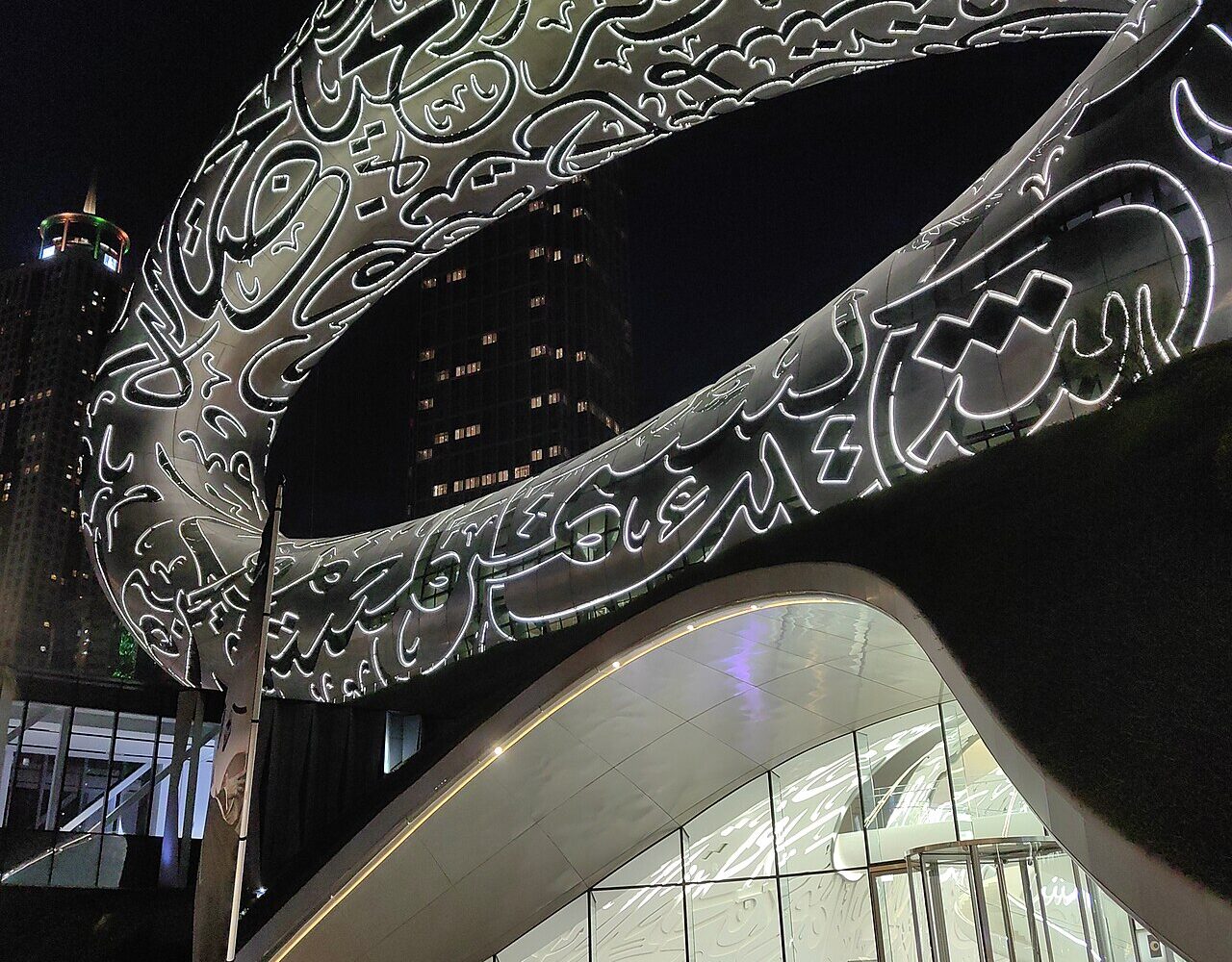
The Museum of the Future, Dubai, at night (illustrative).
Photo: Александр Сигачёв (User:Александр Сигачёв; own work, 10 November 2025 per Exif), CC BY-SA 4.0 — https://creativecommons.org/licenses/by-sa/4.0/ · source
On 5 October 2026 the Dubai Future Foundation (DFF) launched the Agentic AI for Government Services Accelerator. In its first phase, according to the foundation’s official release, 33 Dubai government entities will review more than 300 use cases in services that face the public, to find those best suited to agentic AI, and will work with technology firms that hold the Dubai AI Seal. The Briefing of 9 October carried the launch; this explainer asks what the Seal certifies and what is missing.
How the Accelerator Is Organised
The programme is run by the Dubai Centre for Artificial Intelligence (DCAI), a DFF initiative, with Digital Dubai and the Dubai Electronic Security Center (DESC). It borrows the operating model of Dubai Future Accelerators, built for speed and precision. The National reported that the launch follows directives from Sheikh Hamdan bin Mohammed, Crown Prince of Dubai, to make the emirate the leading city for agentic AI in government services.
DESC’s chief executive, Yousuf Hamad Al Shaibani, said in the release: “Cybersecurity cannot be an afterthought in the adoption of AI.” He named two instruments that will guide participating entities, the Information Security Regulation in Dubai and the AI Security Policy. Neither the release nor The National gives a budget, an end date or a target for services launched.
What the Dubai AI Seal Certifies
The official Dubai AI Seal page, run by DCAI, describes a free classification open to AI businesses operating legally in Dubai. Applicants are sorted into six tiers, from E to S, and each seal carries a serial number that organisations can check on the Seal’s website. The tiers, the page says, reflect “the level of economic contribution” a company makes, with S representing “the highest impact on Dubai’s AI economy”.
In this desk’s reading, that is a test of commercial presence, not of system behaviour. Tiers rest on a firm’s activities, services and current and future projects, assessed under DCAI’s Dubai AI Business Activity Classification System. Nothing on the page describes model testing, audit, validity periods or revocation.
The Seal has since become a gate to public work. On 19 October 2025 Dubai Finance asked government entities to confine contracts for AI-related services and consultancy to Seal holders, citing Article 15 of Law No. (12) of 2020 concerning contracts and warehouse management within the Dubai Government. Five months earlier Gulf News had reported 325 applications and noted that certification was not then mandatory. The Dubai Finance release says applications are judged on “six key areas” but lists only four, including the number of AI-specialised staff and public and private partnerships.
What Is Missing From the Design
Three gaps stand out in this desk’s reading. First, no published test for the agentic services themselves: how a prototype passes, who signs it off, what error rates are tolerable. Second, no incident channel. When agents acting for citizens fail, who must be told, and how fast? That is the subject of this issue’s cover on agent incident-notification rules and of Australia’s experience in The Agent That Would Not Take No. Third, no timetable or budget. Mohammed Soliman of the Middle East Institute told The National when the procurement push began: “The idea is right but the follow through matters.”
How Abu Dhabi’s Route Differs
Abu Dhabi is centralising rather than accelerating. Its Department of Government Enablement announced a Government Digital Strategy 2025–2027 backed by AED13bn, aiming to be a fully AI-native government by 2027, and said more than 95 per cent of its staff of over 30,000 had completed AI training. Its TAMM platform links more than 1,200 services, Gulf News reported, which also cited event information on applications that participating companies were showcasing at AI Everything Abu Dhabi: tools to support around 35,000 government employees and a “digital worker” said to save about $3m a year. Neither figure comes from the Abu Dhabi government, and neither has been independently verified. TAMM 5.0 is due at GITEX Global, 7–11 December 2026, tbreak reported.
The table below, built chiefly from the two governments’ own releases and pages, sets out the contrast.
| Dubai | Abu Dhabi | |
|---|---|---|
| Lead body | DFF / DCAI, with Digital Dubai and DESC | Department of Government Enablement |
| Model | Accelerator: 33 entities, 300+ use cases | Single platform (TAMM) and strategy |
| Money | Not published | AED13bn (2025–2027) |
| Vendor control | Dubai AI Seal, tiers E–S | Not specified in releases |
| Security frame | DESC regulation and AI Security Policy | Sovereign cloud pillar |
| Deadline | None published | 2027 |
What Decision-Makers Should Watch
Governments weighing vendor certification should note the Seal’s strength, a public serial-number check, and its limit: it rates firms, not systems. Watch for DCAI or DESC to publish evaluation criteria and an incident-reporting duty for accelerator services, for the first prototypes to reach citizens, and for whether TAMM 5.0 in December brings comparable disclosure from Abu Dhabi.
Sources
- Dubai Future Foundation Launches Agentic AI for Government Services Accelerator — Dubai Future Foundation — 5 October 2026; official release on dubaifuture.ae
- Dubai launches agentic AI accelerator to transform public-facing government services — The National — 5 October 2026
- Dubai AI Seal — Dubai Centre for Artificial Intelligence — undated; accessed 11 October 2026
- Dubai Finance calls on government entities to contract AI-certified suppliers — Government of Dubai Media Office — 19 October 2025
- UAE goes AI: 325 companies apply for ‘Dubai AI Seal’ so far — Gulf News — last updated 15 May 2025
- Dubai Finance Department urges government agencies to use companies with AI seals — The National — 20 October 2025 (updated 21 October 2025)
- Abu Dhabi Government Digital Strategy 2025–2027 accelerates AI-native government journey — Abu Dhabi Media Office — 30 September 2025
- Abu Dhabi puts AI to work as global race shifts from hype to deployment — Gulf News — last updated 4 October 2026
- Abu Dhabi’s Tamm 5.0 app is coming in December, but the features are still under wraps — tbreak — 7 October 2026
Discussion
No comments yet. Start the conversation.