South Asia’s 7 Per Cent Problem
The World Bank says only 7 per cent of South Asian jobs face high AI exposure without human complementarity. The figure is real, carried over from 2025, and cannot be set beside the Bank's other headline numbers.
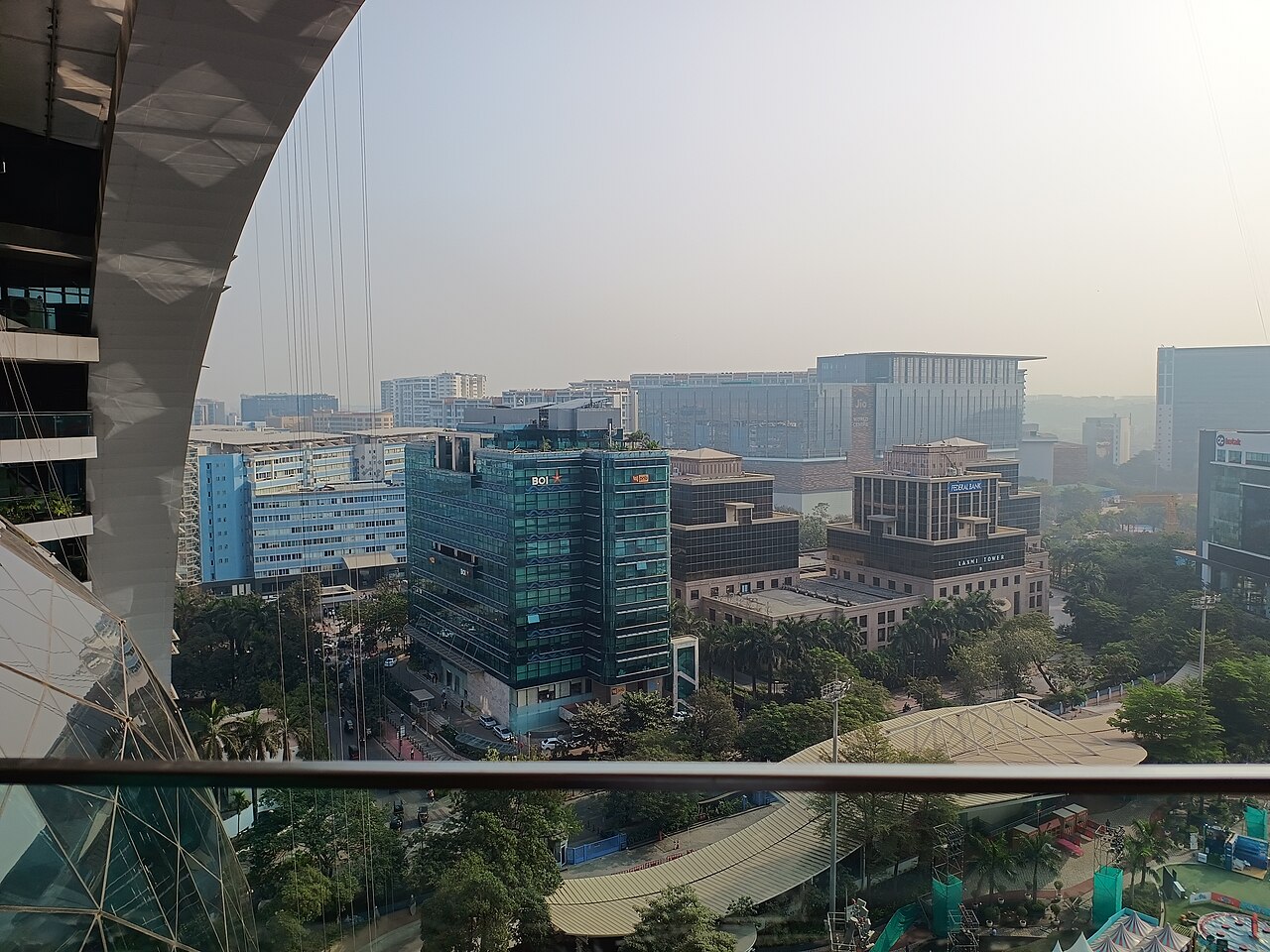
Bank office towers around Jio Garden in Bandra Kurla Complex, Mumbai, where many of the finance and professional-services jobs the World Bank counts as AI-exposed are concentrated (illustrative).
The World Bank’s South Asia Economic Update, Adopting AI for Growth, released on 6 October 2026, tells ministers that their labour markets face less AI automation risk than other developing regions: only 7 per cent of jobs combine high exposure to AI with low complementarity, against 15 per cent in other emerging market and developing economies (EMDEs). Ministries quoting it should know what it measures.
What the Bank Measured, and When
Exposure, in the report, is how far an occupation’s skills overlap with what AI can do; complementarity is how far the worker remains non-substitutable. The 7 and 15 per cent figures are cited not to new fieldwork but to the Bank’s October 2025 South Asia Development Update, Jobs, AI, and Trade. “South Asia” here means six economies: Bangladesh, Bhutan, India, Maldives, Nepal and Sri Lanka. Pakistan and Afghanistan moved into the Bank’s Middle East, North Africa, Afghanistan and Pakistan (MENAAP) region on 1 July 2025, so Islamabad, whose rules for the algorithmic state this magazine examined, sits outside these totals.
The table below, built from the South Asia update and the companion India Development Update for October 2026, gives each figure the Bank’s own definition.
| Figure | What the Bank says it measures | Coverage | Basis |
|---|---|---|---|
| 7% | Share of jobs with high AI exposure but low complementarity (15% in other EMDEs) | Six South Asian economies | October 2025 update, cited in 2026 |
| 15% | Share of workers in jobs where exposure and complementarity are both high; about 70% of AI-exposed jobs and 28% of labour earnings | Six South Asian economies | October 2025 update, cited in 2026 |
| Nearly 30% | Wage premium for vacancies requiring AI skills, estimated from posted salaries within the same occupation | Online job postings | World Bank Group 2026 study |
| 23% (23.4%) | Formal firms with five or more employees using some form of AI (42.7% in the US) | India only; 1,355 firms, 2025–26 | Enterprise Surveys |
| $4.1bn | Private AI investment in 2025, up from about $1.2bn in 2024 | India | India Development Update |
On the Bank’s sophistication index, Indian firms average under one-third of the US level, a gap relevant to India’s Sovereign AI Bet Meets the Price of Silicon.
Why the Bank’s Own Numbers Do Not Line Up
The World Development Report 2026 press release of 4 August says 4.5 per cent of existing jobs in low- and middle-income countries are at risk of automation by generative AI, against 14.2 per cent in high-income countries. The MENAAP Economic Update for October 2026 says “fewer than ten percent of jobs face near-term automation risk”.
Set side by side, South Asia’s 7 per cent looks worse than the developing-world 4.5 per cent. The South Asia report says the region is less exposed than its peers. In this desk’s reading, the apparent contradiction is an artefact of measurement: on the South Asia grid other EMDEs average 15 per cent, triple the WDR’s 4.5 per cent for largely the same countries. The WDR counts generative AI only; the South Asia figure uses an exposure-and-complementarity grid; the MENAAP page speaks of a “near-term” horizon. Neither the WDR press release nor the MENAAP page states its threshold for “at risk”.
Three World Bank numbers, one institution, no common ruler.
Who Is Exposed, and Where
The low share partly reflects the region’s large farm workforce, the Bank notes. Exposure concentrates in finance, ICT and professional services. Hiring has slowed at highly exposed firms, which may reflect automation or caution, the Bank says. Foreign buyers could also reshore automatable work, leaving lower-value outsourcing such as customer support most exposed. The Kathmandu Post reported that Gaurav Raj Pandey, former president of the Nepal Association for Software and IT Services Companies, also sees an export opening.
What the Bank Asks of Ministries
For education ministries, the report names analytical and social skills as what makes workers complementary to AI, against adult literacy of around 75 per cent (85 per cent across EMDEs). For labour ministries: sectoral programmes that pair job matching with occupational and soft-skills training, plus social protection for displaced workers. For finance and industry: cloud-service vouchers or pooled purchasing for small firms, and standards and directories for private consultants who advise firms. The regional press release adds a clear regulatory framework that protects data security and privacy, an agenda India is now consulting on (India drops the light touch). Franziska Ohnsorge, the Bank’s Chief Economist for Asia, said the adoption of AI “has the potential to transform South Asia’s development trajectory by boosting labor productivity”.
What to Watch
Ministries quoting the 7 per cent should cite it as a 2025 estimate for six economies, never beside the WDR’s 4.5 per cent. The firm survey covers India alone, leaving Dhaka, Kathmandu and Colombo without an adoption baseline. The useful ask of the Bank is country-level exposure tables under one method.
Sources
- South Asia Economic Update: Adopting AI for Growth (October 2026) — World Bank — October 2026; (PDF)
- India Development Update — October 2026: India and Artificial Intelligence: Seizing the Development Opportunity — World Bank — October 2026; (PDF)
- AI Offers Lifeline to Developing Economies in an Era of Weak Growth (World Development Report 2026) — World Bank — 4 August 2026
- Middle East, North Africa, Afghanistan & Pakistan Economic Update — October 2026: From Divide to Opportunity: AI, Jobs, and Growth — World Bank — October 2026
- AI reshapes South Asia’s jobs, creating risks and new opportunities — The Kathmandu Post — 8 October 2026
- South Asia’s Strong Growth Defies Global Headwinds — World Bank — 6 October 2026
Discussion
No comments yet. Start the conversation.