Brazil’s Election Court Trades Bans for Disclosure
Brazil's electoral court has ordered Flávio Bolsonaro to delete an AI post about Lula that carried no disclosure. With the run-off on 25 October, disclosure is now doing most of the court's work, and it reaches few of the accounts posting AI content.
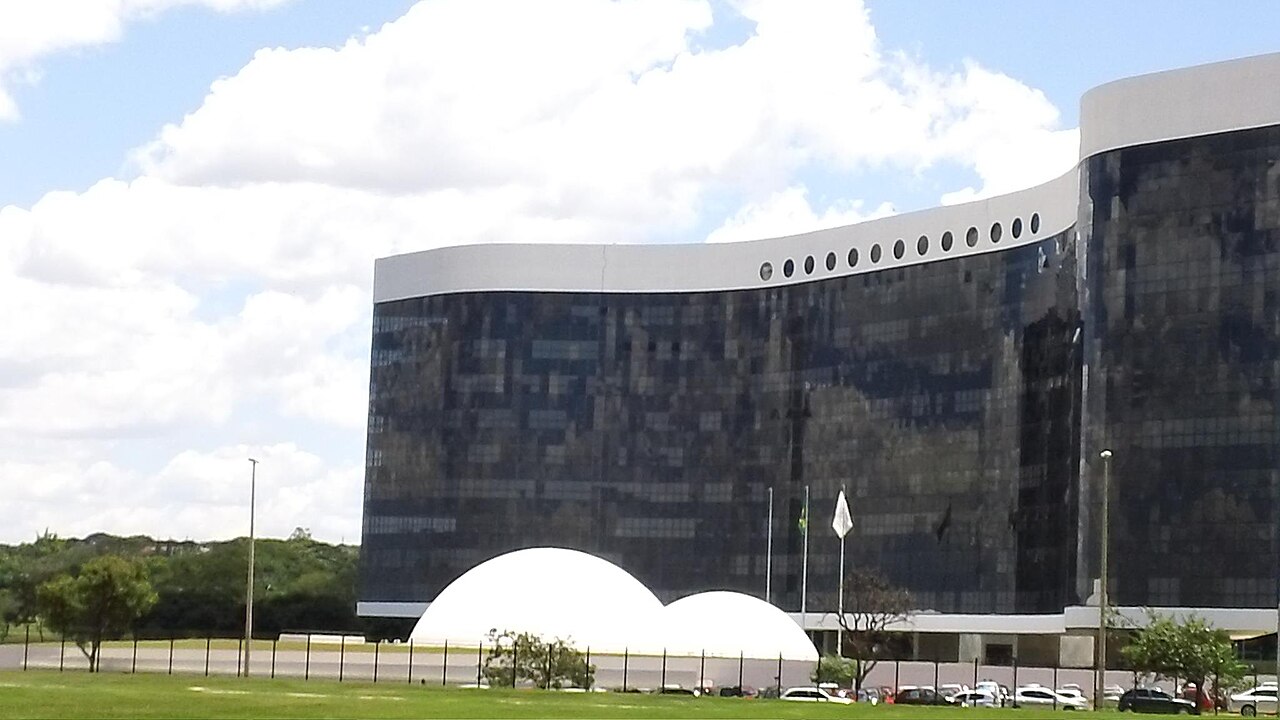
The headquarters of Brazil's Superior Electoral Court (TSE) in Brasília, photographed in March 2012.
Photo: Alexandresena, CC BY-SA 4.0 · source
Key points
- On 8 October 2026 Brazil’s Superior Electoral Court unanimously ordered Flávio Bolsonaro to remove within 24 hours three X posts about President Lula, one of them an AI-made depiction that lacked the disclosure required by art. 9º-B of Resolution 23.610/2019.
- Since the court’s 1 September thesis confined the deepfake ban to realistic AI content used as propaganda, labelling decides most cases: a 22 September interim order, reported by CNN Brasil, held a label no defence for a deepfake, while the 8 October ruling turned on a missing label.
- Agência Lupa’s VigIA project counted 920 AI-made political posts between 16 August and 28 September, 549 of them (60 per cent) with no AI disclosure, and about three-quarters came from accounts that belong to neither candidates nor parties.
Brazil’s Superior Electoral Court (Tribunal Superior Eleitoral, TSE) has turned its AI disclosure rule on one of the two men left in the presidential race. On 8 October the full court ordered Senator Flávio Bolsonaro (PL) to take down three posts on X, one because it showed President Luiz Inácio Lula da Silva (PT) in an invented, AI-made scene without saying so. The case shows where the court’s AI regime now rests. Since the TSE narrowed its deepfake ban in September, a disclosure notice has become the main legal test for most synthetic campaign material. Monitoring data show that most of that material is posted by people the rule barely reaches.
What the Court Ordered, and Why One Post Turned on Disclosure
The case, Rp nº 0600955-65.2026.6.00.0000, was brought by the Federação Brasil da Esperança, the PT-led alliance with PCdoB and PV, which argued that posts published on 30 and 31 May were negative early campaigning against Lula. The rapporteur, Minister André Mendonça, reversed his earlier refusal of an urgent injunction. CNN Brasil reported that the six other ministers, including the court’s president, Kassio Nunes Marques, joined him.
Two posts linked Lula, then a pre-candidate, to the PCC and Comando Vermelho criminal factions; Mendonça found that doing so without a minimum factual basis exceeds political criticism and can amount to grave decontextualisation. The third is the AI case. According to CNN Brasil, Mendonça accepted that the post looked caricatural and fanciful but held that its failure to identify the use of AI breached the transparency duty. Poder360 gave the same account. Flávio Bolsonaro has 24 hours to comply under a daily fine whose amount none of these reports states; he may not republish the material, and X is to be notified. Neither outlet reported a response from him or his lawyers.
The docket cuts both ways. The same day, CNN Brasil reported, Mendonça ordered deputies André Janones and Lindbergh Farias to remove a video that, in his view, attributed proposals to Flávio Bolsonaro without concrete support; the report does not say AI was involved. Flávio Bolsonaro, for his part, has filed an electoral investigation action (AIJE) against Lula, according to CNN Brasil’s Caio Junqueira; the filing alleges that Instagram profiles linked to Lula’s re-election campaign spread false claims. No court has ruled on it, and Lula’s campaign told CNN Brasil it had not been notified. The run-off on 25 October pits Flávio Bolsonaro, on 47.03 per cent of valid first-round votes, against Lula on 45.16 per cent, according to Agência Brasil.
How the 1 September Thesis Split the AI Rules in Two
The shift began with the court’s 1 September thesis on deepfakes, adopted 5–2. It held that the ban in art. 9º-C, § 1º covers only synthetic content made or altered with AI or equivalent technology, with some realism, that changes a person’s image, voice or statements, and only when it is electoral propaganda. This publication’s earlier analysis of the TSE as Brazil’s de facto AI regulator examined that vote.
Two later decisions show what the thesis leaves. On 22 September, CNN Brasil reported, Nunes Marques issued an interim order, subject to the full court’s endorsement, for Flávio Bolsonaro to remove an AI video about Lula’s son, holding that its AI notice, though compliant with art. 9º-B, was no exception to the deepfake ban. On 8 October the court removed a caricature because it lacked a notice. In this desk’s reading, the result is a two-track regime: realistic impersonation is prohibited whatever the label, and other synthetic content is lawful if disclosed. The higher the realism threshold, the more work the label does.
The table below, built from the compiled text of TSE Resolution 23.610 of 18 December 2019 as amended in 2024 and 2026, sets out what a label can cure.
| Conduct | Provision | Label cures it? | Consequence |
|---|---|---|---|
| AI-made or AI-altered propaganda | Art. 9º-B caput, § 1º | Yes, if “explícito, destacado e acessível” and naming the technology | Removal (§ 4º) |
| Quality fixes, visual identity, routine montages | Art. 9º-B § 2º | Exempt | None |
| Chatbots or avatars simulating dialogue with a real person | Art. 9º-B § 3º | No | Removal (§ 4º) |
| New synthetic content using a candidate’s image or voice, 72 hours before to 24 hours after the vote | Art. 9º-B § 3º-A | No | Removal (§ 4º) |
| Manipulated content spreading notoriously false or decontextualised facts | Art. 9º-C caput | No | Abuse of power; registration or mandate at risk (§ 2º) |
| Deepfake to harm or favour a candidacy, even with consent | Art. 9º-C § 1º | No | As above |
| Platform failing to take down non-compliant AI content | Art. 9º-E, V | n/a | Joint civil and administrative liability |
A Dated Timeline From Resolution to Run-off
- 27 February 2024: Resolution 23.732 inserts the disclosure rule (art. 9º-B) and the deepfake ban (art. 9º-C).
- 2 March 2026: Resolution 23.755 adds the 72-hour window, an AI declaration field for paid boosting and a reversible burden of proof, and rewrites platform liability.
- 30–31 May 2026: Flávio Bolsonaro publishes the three posts.
- 16 August 2026: VigIA monitoring begins.
- 1 September 2026: Deepfake thesis fixed.
- 22 September 2026: Labelled AI video about Lula’s son ordered down.
- 1–5 October 2026: First 72-hour window; first round on 4 October.
- 8 October 2026: Full court orders the three posts removed.
- 25 October 2026: Run-off.
Where the Disclosure Duty Runs Out
The duty in art. 9º-B falls on whoever uses synthetic content in propaganda, and most of that content sits outside campaigns. Agência Lupa’s VigIA report of 1 October, produced with partners including Unicamp’s Recod.AI lab, confirmed 920 AI-made political posts between 16 August and 28 September. Of these, 554 were deepfakes and 549 carried no notice; the two figures, each about 60 per cent, measure different things. Of the 371 with some notice, platforms applied 219 and the account, author or campaign only 152. Ordinary users, voters or activists posted 434 items and anonymous or avatar accounts 251, against 226 from official candidate profiles and six from parties. RBN reported that 75 unlabelled posts came from candidates or parties.
A disclosure rule binds those the court can reach; the volume sits with those it cannot.
Lupa’s founder, Cristina Tardáguila, argued that because campaigns know they can be punished, misuse shifts to supporters who count on impunity. The first-round blackout fits that pattern: Lupa found 64 AI posts in the 72-hour window, only four from official candidate accounts, and 61 were still online on 7 October. Speed is a second gap: the 8 October ruling concerned posts more than four months old.
That leaves platforms as the practical enforcers under art. 9º-E. It is the lesson this publication’s Slopaganda analysis drew: rules aimed at campaigns can be enforced, rules aimed at every user rarely can. China shows the opposite risk, where a mandatory label became cover for fake personas.
What to Watch Before 25 October
The second 72-hour window opens on 22 October. Watch whether X complies and what fine the court sets; whether platforms again out-label the accounts that post; and whether judges pursue anonymous networks through art. 9º-E rather than complaints against candidates. For governments drafting election AI rules, Brazil’s choice is instructive: a disclosure-first regime is lighter on speech, but it works only if platforms must detect, label and remove at scale.
Questions this answers
What did Brazil’s electoral court decide about Flávio Bolsonaro’s AI post?
On 8 October 2026 the TSE unanimously ordered him to remove three X posts about Lula within 24 hours, under a daily fine, and barred republication. One was an undisclosed AI depiction; two linked Lula to criminal factions without factual basis, according to the TSE.
Is AI-generated campaign content legal in Brazil’s 2026 election?
Mostly yes, if disclosed explicitly and prominently under Resolution 23.610. Realistic deepfakes used as propaganda remain banned even when labelled, as does new synthetic content of candidates in the 72 hours before a vote.
How much AI election content in Brazil was unlabelled?
Agência Lupa’s VigIA project found that 549 of 920 AI-made political posts (60 per cent) carried no notice between 16 August and 28 September. About three-quarters came from users or anonymous accounts rather than candidates or parties.
Sources
- TSE manda retirar do ar vídeos com uso de IA publicados por Flávio Bolsonaro — Tribunal Superior Eleitoral — 8 October 2026; (in Portuguese; translation by AI & GPP)
- TSE manda Flávio apagar vídeos com IA que associam Lula a facções — CNN Brasil — 8 October 2026; (in Portuguese; translation by AI & GPP)
- TSE manda Flávio Bolsonaro apagar posts com IA contra Lula — Poder360 — 8 October 2026; (in Portuguese; translation by AI & GPP)
- Mendonça determina remoção de vídeo de Janones e Lindbergh contra Flávio — CNN Brasil — 9 October 2026; (in Portuguese; translation by AI & GPP)
- Flávio aciona TSE contra “campanha do medo” com fake news em massa pró-Lula — CNN Brasil (Caio Junqueira) — 8 October 2026; (in Portuguese; translation by AI & GPP)
- Quando será o segundo turno das eleições? Veja data — Agência Brasil — 4 October 2026; (in Portuguese; translation by AI & GPP)
- TSE fixa tese sobre deepfake e delimita regra para as Eleições 2026 — Tribunal Superior Eleitoral — 1 September 2026; (in Portuguese; translation by AI & GPP)
- Nunes Marques manda Flávio retirar vídeo com IA sobre Lulinha e INSS — CNN Brasil — 22 September 2026; (in Portuguese; translation by AI & GPP)
- Resolução nº 23.610, de 18 de dezembro de 2019 (compiled text) — Tribunal Superior Eleitoral — as amended by Res. 23.755/2026; (in Portuguese; translation by AI & GPP)
- VigIA: 1º turno tem quase um conteúdo eleitoral com IA por hora nas redes — Agência Lupa — 1 October 2026; (in Portuguese; translation by AI & GPP)
- Levantamento aponta 554 deepfakes durante primeiro turno das eleições de 2026 — RBN 94,3 FM — 2 October 2026; (in Portuguese; translation by AI & GPP)
- Conteúdos com IA circulam em período proibido pela lei eleitoral — Agência Lupa — 7 October 2026; (in Portuguese; translation by AI & GPP)
Discussion
No comments yet. Start the conversation.