India Drops the Light Touch on AI
On one day New Delhi promised a regulation-focused AI consultation paper and privately told platforms to label misleading content. The move from voluntary guidelines to rule by advisory leaves one question open: under what legal authority?
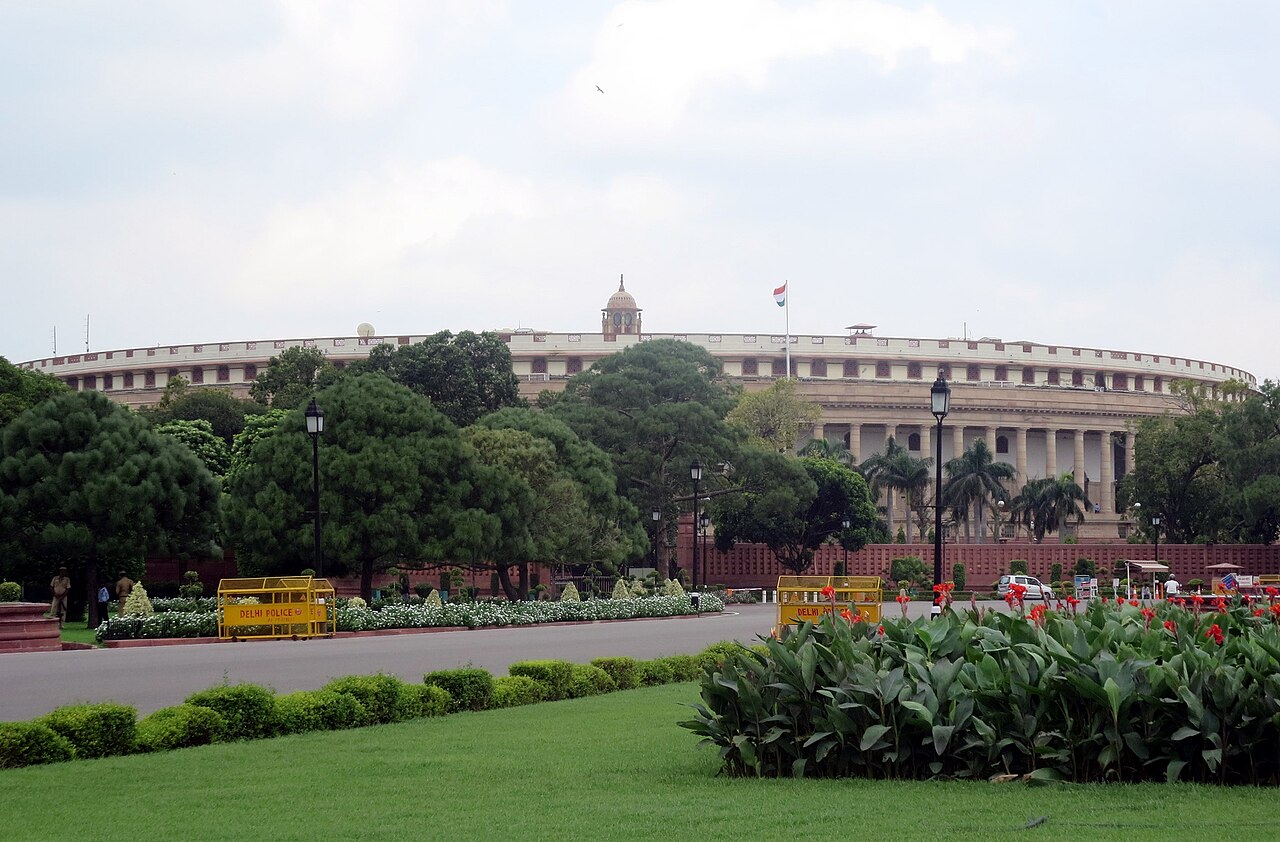
The old Sansad Bhavan, India's former Parliament House, in New Delhi (illustrative).
Photo: Nikhilb239, CC BY-SA 4.0 · source
Key points
- On 8 October 2026 India’s IT minister, Ashwini Vaishnaw, said the Ministry of Electronics and Information Technology (MeitY) would publish a regulation-focused AI consultation paper within a month, eleven months after guidelines that judged a separate AI law unnecessary.
- The same day, MeitY’s Cyber Laws Division sent social media platforms an unpublished advisory asking them to label or contextualise “manipulated, synthetically generated or misleading” content, a wider net than the February 2026 IT Rules, which cover only synthetic audio-visual material.
- The advisory names no specific enabling provision and lists no penalty, and the Internet Freedom Foundation has called for its withdrawal, arguing that “enhanced diligence” has no basis in the IT Rules.
India spent most of the past year saying it did not need an AI law. On Thursday 8 October that position shifted twice. In public, at the India event for the World Bank’s World Development Report 2026: The Promise of Artificial Intelligence, the Minister of Electronics and Information Technology, Ashwini Vaishnaw, promised a consultation paper that is “probably (the) base for the regulation which has to come”, according to ThePrint. In private, his ministry sent platforms an unpublished advisory on misleading and synthetic content. For now the second move matters more: it shows how the state intends to govern AI-era content before any statute exists.
What the Minister Promised, and What the Paper Will Cover
PTI’s report, carried by ThePrint, reports that Mr Vaishnaw asked his department for a consultation paper focused on regulation, with safety at its centre. It would also cover deepfakes, which he called a “nuisance which can cause huge problems in society”, a human-first approach and skilling. On who carries the load he was explicit: “The industry has to take the primary responsibility,” he said, listing cybersecurity, user harm and psychological disorders.
He repeated the government’s view that law alone cannot govern the technology and that India needs a techno-legal answer. Business Standard reported that India still has no unified AI law, so most AI services fall under the Information Technology Act, 2000, and its rules. MeitY’s secretary, S Krishnan, said the World Bank report recommends a sequence much like India’s: existing laws first, then voluntary compliance, then regulation. “Maybe some of those times have come,” he said, in ThePrint’s account.
That is a real departure. The India AI Governance Guidelines, unveiled on 5 November 2025 and drafted by a committee chaired by Professor Balaraman Ravindran of IIT Madras, concluded that “at this stage, a separate law to regulate AI is not needed given the current assessment of risks”. They favoured voluntary commitments, with a possible compliance schedule “in the next 9-12 months”. At the launch, the government’s press release quoted Mr Krishnan stressing “existing legislation wherever possible”.
Four Instruments in Eleven Months, and What Each One Binds
The table below, built from MeitY’s own documents and contemporaneous reporting, sets out the four instruments and their legal weight.
| Date | Instrument | Legal form | Who it binds, and how | Consequence of non-compliance |
|---|---|---|---|---|
| 5 Nov 2025 | India AI Governance Guidelines | MeitY policy guidance | No one; voluntary commitments | None |
| 10 Feb 2026 (in force 20 Feb, per MediaNama) | IT Rules amendment, G.S.R. 120(E) | Subordinate legislation (s.87, IT Act) | Platforms whose tools create synthetic audio-visual content: labels and permanent metadata (Rule 3(3)); large platforms: user declarations, verified (Rule 4(1A)) | Loss of s.79 safe harbour |
| 8 Oct 2026 | Advisory on misinformation and public order | Unpublished letter, Cyber Laws Division | All social media intermediaries: label or contextualise manipulated, synthetic or misleading content, text included; prioritise government complaints | None listed |
| c. 8 Nov 2026 (expected) | Regulation-focused consultation paper | Consultation | No one yet | n/a |
The February rules are the only instrument here with clear legal force. The consolidated IT Rules published by MeitY define synthetic content narrowly, as computer-made or altered audio, visual or audio-visual material that appears real, with exemptions for routine editing and accessibility. A Lok Sabha answer from the Minister of State, Jitin Prasada, released on 6 August 2026, adds that the amendment cut the deadline for removing unlawful content after a government notice or court order from 36 hours to three, and that non-compliant platforms lose their section 79 exemption.
How the Advisory Widens the Net Without a New Rule
MeitY has not published the advisory. It was first reported by MediaNama, which reproduced its text; ThePrint says it has seen a copy. Bearing the signature of Joint Secretary Ajit Kumar, it seeks “enhanced diligence” over false, out-of-context or manipulated material that could disturb public order, singling out recycled photographs and videos, synthetic audio-visual content and impersonation of public authorities. Platforms are to “identify and appropriately label/contextualise manipulated, synthetically generated or misleading content”, give priority to complaints from “authorised Government agencies” and cooperate with law enforcement. In the copy MediaNama reproduced, the clause numbering skips from (iv) to (vi).
Three features stand out. First, “misleading” content in any format, text included, falls inside the labelling ask, which the February definition deliberately excluded, as ThePrint’s report on the advisory also notes. Second, it defines neither “authorised Government agencies” nor “priority”. Third, it states no consequence, unlike MeitY’s advisories on Red Fort blast content in November 2025 and obscene content in December 2025, which, MediaNama notes, warned platforms of legal costs. This desk found no copy on meity.gov.in on 11 October 2026.
The text names no events; the link to politics is the outlets’ inference. MediaNama noted that it came nearly a week after the start of Delhi street protests over electoral-roll revision directed at the Chief Election Commissioner, Gyanesh Kumar. The Week reported that INDIA bloc MPs marched towards the Election Commission on 6 October over the Special Intensive Revision (SIR) and were stopped by Delhi Police. PTI, carried by Deccan Chronicle, citing unnamed sources aware of the development, reported that the advisory asks platforms to act first on unlawful material linked to the protests.
The Case For, and the Case Against
The government’s case is practical. Recycled footage and impersonation are live problems in contested moments: ThePrint reported that on 26 September Delhi Police described a Jantar Mantar protest video shared online as “archived material from a past event”. The advisory says it aims to protect public order “while respecting lawful expression and legitimate public discourse”. Putting the burden on industry fits the techno-legal model the guidelines endorsed, and the minister’s deepfake concerns echo the Prime Minister’s call for visibility into where AI content originates.
The Internet Freedom Foundation’s response is the sharpest counter-argument. It says no provision empowers MeitY to issue such advisories; that section 79(2)(c) of the IT Act ties safe harbour to diligence the government must “prescribe” by rules; and that “enhanced diligence” appears in neither Rule 3 nor Rule 4. Users, it adds, will see a platform’s decision but not the government complaint behind it, closing off a route to court. It wants the advisory published and withdrawn, or clarified as creating no new obligation.
An advisory with no penalty can still change behaviour, because the platform cannot know which ignored request becomes the test case for its safe harbour.
In this desk’s reading, both sides describe the same mechanism: an advisory needs no legal force if recipients judge compliance cheaper than finding out. The pattern recurs elsewhere, as in Turkey’s choice to govern AI by circular. India’s version matters more because of scale, and because one ministry is both the AI industry’s patron, as its compute programme shows, and its content regulator, while also building citizen-facing services such as the DigiLocker assistant covered in this issue.
What to Watch Before the Paper Lands
Decision-makers should test the consultation paper, due around 8 November if the minister’s timetable holds, on three points. Does it propose statutory footing, or more guidance? Does it keep the February rules’ audio-visual definition of synthetic content or adopt the advisory’s broader “misleading” standard? Does it say who counts as an “authorised” complainant and whether users will be told? Platforms should document how they handle requests under the advisory now, since the paper may turn informal practice into rule.
Questions this answers
Is India regulating AI by law now?
Not yet. The only binding AI-specific measure is the February 2026 amendment to the IT Rules on synthetic audio-visual content, according to MeitY’s consolidated rules. The minister has promised a consultation paper within a month as the basis for broader regulation.
What does the 8 October MeitY advisory ask platforms to do?
According to the text published by MediaNama, it asks platforms to label or contextualise manipulated, synthetic or misleading content and to prioritise public-order complaints from authorised government agencies. It lists no penalty and MeitY has not published it.
Why do civil liberties groups object?
The Internet Freedom Foundation argues that the advisory has no statutory basis, invents an “enhanced diligence” standard absent from the IT Rules and will push platforms to over-remove protest speech without telling users the state was involved.
Sources
- India steps up AI regulation push with consultation paper likely next month. Deepfakes, safety in focus — ThePrint — 8 October 2026
- AI regulations: Consultation paper in a month; safety, deepfakes among key focus areas, says Vaishnaw — ThePrint (PTI) — 8 October 2026
- Govt to release consultation paper on AI regulations in 30 days: Vaishnaw — Business Standard — 8 October 2026
- India AI Governance Guidelines: Enabling Safe and Trusted AI Innovation — Ministry of Electronics and Information Technology / IndiaAI — November 2025; (PDF)
- MeitY Unveils India AI Governance Guidelines under IndiaAI Mission — Press Information Bureau — 5 November 2025
- The Information Technology (Intermediary Guidelines and Digital Media Ethics Code) Rules, 2021 [updated as on 10.02.2026] — Ministry of Electronics and Information Technology — updated as on 10 February 2026; (PDF)
- Government Strengthens Regulatory Framework to Address AI-Generated Deepfakes — Press Information Bureau — 6 August 2026
- Exclusive: Amid protests, MeitY widens labelling for social media beyond synthetic content — MediaNama — 8 October 2026
- Amid SIR stir, MeitY asks social media platforms to prioritise govt complaints, label misleading content — ThePrint — 8 October 2026
- ‘Gyanesh, it’s done, bro’: INDIA bloc takes protest to streets as SIR row heats up — The Week — 6 October 2026
- Govt Advises Social Media Platforms To Prioritise Action Against Unlawful Protest Content — Deccan Chronicle (PTI) — 9 October 2026
- MeitY’s “enhanced diligence” advisory pressures platforms to police protest speech. It must be withdrawn. — Internet Freedom Foundation — 9 October 2026
Discussion
No comments yet. Start the conversation.