Tokyo Asks for Nearly Six Times More AI Money, Robots First
Japan's ministries have requested ¥2.94tn for AI in fiscal 2027, up from ¥502.7bn this year. The biggest cheque is for robot-ready foundation models, while the AI law still carries no penalties.
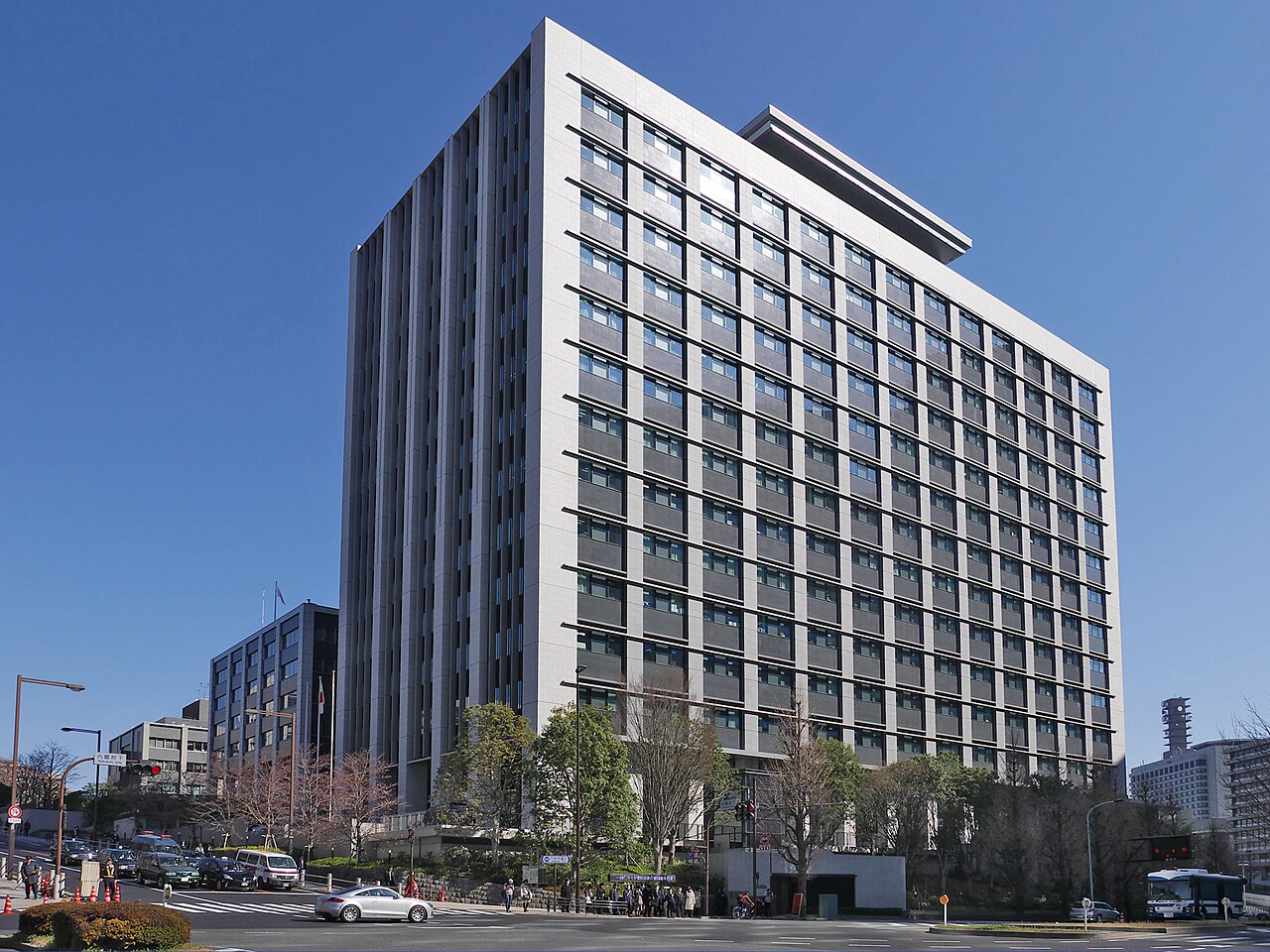
Central Common Government Offices No. 8 in Nagatacho, Tokyo, which houses the Cabinet Office's science, technology and innovation secretariat that compiles Japan's AI budget figures.
Photo: Mytho88, CC BY-SA 4.0 · source
Key points
- Japan’s Cabinet Office tallies ¥2兆9,392億円 (about ¥2.94tn) of AI-related budget requests for fiscal 2027 against ¥502.7bn in the fiscal 2026 initial budget, plus 26 requests with no amount attached.
- The single largest request is ¥896.4bn from the Ministry of Economy, Trade and Industry for multimodal foundation models aimed at AI robots and physical AI, up from ¥387.3bn this year.
- These are requests, not appropriations: the figures will be assessed before the government compiles its fiscal 2027 budget proposal at year-end.
Japan’s ministries want to spend almost six times as much on artificial intelligence next year as they do this year. A Cabinet Office summary of the fiscal 2027 AI-related budget requests (in Japanese), published on 18 September, puts the total at ¥2.94tn, against ¥502.7bn in the fiscal 2026 initial budget. The money goes to building and deploying AI, above all in machines that act in the physical world, not to policing it. For governments choosing between statute and subsidy, Tokyo is now running a large-scale test of the second.
Where the Requested Yen Would Go
The table below, built from the Cabinet Office summary, lists every item it prices at ¥15bn or more. Together they account for roughly ¥2.11tn, or about 72 per cent of the total.
| Ministry | Purpose (as described by the Cabinet Office) | FY2027 request |
|---|---|---|
| METI | Multimodal foundation models for AI robots and physical AI | ¥896.4bn |
| MEXT | “AI for Science” research programme | ¥378.9bn |
| METI | AI transformation (AX), efficiency and digital support for SMEs (new) | ¥374.6bn |
| METI | Centre of Excellence for AI robotics (new) | ¥133.3bn |
| Cabinet Office | Deployment and development of sector-specific “vertical AI” (new) | ¥100.9bn |
| MEXT | Safe AI use in schools, including teacher training | ¥88.4bn |
| MIC | Platform to actively evaluate AI reliability | ¥46.0bn |
| MIC | Next-generation information and communications infrastructure | ¥45.0bn |
| MLIT | AI for weather forecasting (new) | ¥30.5bn |
| MHLW | “AI for Health” drug-discovery and medical platform (new) | ¥15.3bn plus unpriced request |
Source: Cabinet Office FY2027 summary; amounts rounded. METI: economy and industry; MEXT: education and science; MIC: internal affairs and communications; MLIT: land and transport; MHLW: health and labour.
Several strategic lines carry no number. The Digital Agency’s government AI platform, Gennai, METI’s GENIAC compute programme, a Ministry of Defense project on AI-assisted decision-making and a Cabinet Secretariat cyber-security package, Project YATA-Shield, are “item-only” requests, entered without an amount and left out of the total.
The robot tilt is plain. The physical-AI model line and the new robotics centre together come to ¥1.03tn, about 35 per cent of everything priced. The physical-AI line itself already existed: the Cabinet Office’s fiscal 2026 AI budget summary (in Japanese) lists it as a new ¥387.3bn item this year, so the request is a 2.3-fold step-up on a programme that has barely started. Prime Minister Sanae Takaichi set the direction at the fifth meeting of the AI Strategy Headquarters on 10 July 2026 (in Japanese), telling ministers to push investment in vertical and physical AI and speed robots into use.
Why “Six-Fold” Overstates the Like-for-Like Jump
First, the comparison sets a wish list against an enacted budget. Under the Cabinet’s 30 July 2026 guidelines for fiscal 2027 requests (in Japanese), the government created a new “Strong and Prosperous Japan” investment framework with no request ceiling, and invited ministries to submit amounts, or items without amounts, for growth investment.
Second, the same guidelines tell ministries to break the habit of funding recurring policy through supplementary budgets and to book it in the initial budget instead. The Cabinet Office’s chart of AI-related spending since fiscal 2017 (in Japanese) shows a ¥438.0bn AI supplementary for fiscal 2025 alongside the ¥502.7bn fiscal 2026 initial budget. By this desk’s calculation, adding the two gives a fiscal 2026 baseline of about ¥940.7bn (¥502.7bn plus ¥438.0bn), against which the ¥2.94tn request is roughly 3.1 times larger, not six. Part of the jump is money moving from one budget vehicle to another.
Third, the programme set has changed. According to the Cabinet Office summaries, the fiscal 2027 request covers 132 new and 193 continuing measures; the fiscal 2026 budget covered 20 new and 129 continuing ones. Both also exclude measures whose AI share cannot be separated out. The baskets are similar, not identical.
In this desk’s judgement, even the conservative reading, a tripling, marks a real change in Japan’s fiscal posture towards AI.
Robots, Not Rules: The Law Behind the Spending
Japan regulates AI through a promotion statute. The Act on Promotion of Research and Development, and Utilization of AI-related Technology (Act No. 53 of 2025, in Japanese), promulgated on 4 June 2025 and fully in force since 1 September 2025, creates an AI Strategy Headquarters chaired by the Prime Minister and requires an AI Basic Plan. The government’s English outline of the act states the aim of making Japan “the friendliest country to develop and utilize AI”.
Its hardest tool is soft. Article 16 directs the state to study cases where AI misuse has harmed people’s rights and respond with guidance, advice and information; Article 7 obliges businesses using AI to cooperate with government measures. The full text on e-Gov contains no penal provisions.
The spending mix mirrors that design. In the fiscal 2026 summary, the governance pillar came to just ¥1.1bn out of ¥502.7bn. In the fiscal 2027 request, the largest trust-related item, the ¥46.0bn reliability-evaluation platform, sits under the development pillar, while the governance pillar’s named measures, including safety and risk evaluation of high-performance AI at the AI Safety Institute, carry no priced amount.
Japan is testing whether a state can buy trustworthy AI through evaluation capacity rather than legislate for it.
The rules are not frozen. In July Takaichi said related systems, including the AI Act, would be reviewed so the government can evaluate high-performance AI, and the AI Safety Institute strengthened. At the eighth meeting of the Japan Growth Strategy Council (in Japanese), she instructed three ministers to produce by year-end a concrete picture of AI transformation, principles for regulatory and institutional reform suited to it, and an action plan to speed up AI’s deployment. “The societal implementation of high-performance AI is essential for realizing the government’s growth strategy,” she said, as Jiji Press reported via Nippon.com. The reform principles are framed around clearing the way for AI.
How Seoul’s Compute-First Plan Compares
South Korea’s new frontier programme points its money elsewhere. Korea JoongAng Daily reported on 5 October that the government’s 2027 budget proposal allocates KRW4.7tn to a new frontier AI model programme, of which KRW3.85tn, about 82 per cent, is for GPU capacity, with no plan yet for how the chips will be distributed. The Ministry of Science and ICT will run its sovereign-model competition as two tracks, one for frontier development and one for industrial deployment. Seoul Economic Daily reported that support will concentrate on 10,000 Nvidia Vera Rubin GPUs, and that the frontier programme is designed around equity investment.
Korea is buying chips to chase the frontier; Japan is buying models to put AI into factories, laboratories, small firms and robots. Both sit inside the sovereign-compute contest traced in Two Blocs, One Technology, and both face the cost pressures described in India’s Sovereign AI Bet Meets the Price of Silicon.
What to Watch Before the Year-End Budget
Neither country’s figures are final. In Japan, Jiji reports that the growth-strategy implementation programme will be compiled at year-end alongside the government’s fiscal 2027 budget proposal, which must then pass the Diet. In Korea, the frontier programme’s call opens only after the National Assembly finalises the budget at year-end, according to JoongAng.
Officials and investors should watch three things: how much of the ¥2.94tn survives the Finance Ministry’s assessment, and whether the multi-year special account the guidelines describe takes physical-AI money off the annual cycle; what the year-end reform principles actually loosen, and for whom; and whether the evaluation platform and the AI Safety Institute are funded in proportion to the systems Japan is paying to build. A state that funds robots at ¥896.4bn and governance through an unpriced line has made a choice, and should be judged on it.
Questions This Answers
How much is Japan planning to spend on AI in fiscal 2027?
Ministries have requested ¥2.94tn plus 26 unpriced items, according to the Cabinet Office summary, against ¥502.7bn in the fiscal 2026 initial budget. The requests are not yet approved, and by this desk’s calculation, adding the fiscal 2025 AI supplementary of ¥438.0bn to the baseline, the rise is nearer threefold.
Is Japan regulating AI or promoting it?
Mainly promoting it. The AI Promotion Act relies on guidance, advice and cooperation duties and has no penal provisions; the 1 October instruction seeks reform principles that ease deployment.
How does Japan’s AI budget compare with South Korea’s?
Korea’s 2027 proposal puts KRW4.7tn into a frontier model programme, KRW3.85tn of it for GPUs, according to JoongAng Daily. Japan’s largest request is for physical-AI models, not chips.
Sources
- 令和9年度AI関連予算要求について — Cabinet Office (Japan) — published 18 September 2026 (per CAO AI page); (PDF) (in Japanese; translation by AI & GPP)
- 令和8年度AI関連予算について — Cabinet Office (Japan) — undated; (PDF) (in Japanese; translation by AI & GPP)
- AI関連予算の推移(平成29年度~令和8年度) — Cabinet Office (Japan) — undated; (PDF) (in Japanese; translation by AI & GPP)
- 人工知能戦略本部(第5回) — Prime Minister’s Office of Japan — 10 July 2026; (in Japanese; translation by AI & GPP)
- 令和9年度予算の概算要求に当たっての基本的な方針について — Cabinet (Ministry of Finance) — 30 July 2026; (PDF) (in Japanese; translation by AI & GPP)
- 人工知能関連技術の研究開発及び活用の推進に関する法律(令和七年法律第五十三号) — e-Gov Law Search — promulgated 4 June 2025; (in Japanese; translation by AI & GPP)
- Outline of the Act on Promotion of Research and Development, and Utilization of AI-related Technology (AI Act) — Cabinet Office (Japan) — undated; (PDF) provisional English outline
- 日本成長戦略会議(第8回) — Prime Minister’s Office of Japan — 1 October 2026; (in Japanese; translation by AI & GPP)
- Japan to Compile Action Plan for Spreading AI Use — Jiji Press / Nippon.com — 1 October 2026
- Korea splits AI push into two tracks amid confusion over sovereign model project — Korea JoongAng Daily — 5 October 2026
- Korea’s AI Model Project to Proceed With Third Round as Planned — Seoul Economic Daily — 5 October 2026
Discussion
No comments yet. Start the conversation.