Israel Votes on AI Rules That Have Yet to Bite
Israel's election authority wrote AI disclosure rules in July, then took two AI videos down on older grounds and decided nothing under the new duty. In the closing week the only state action on AI content came from the security service, not the committee.
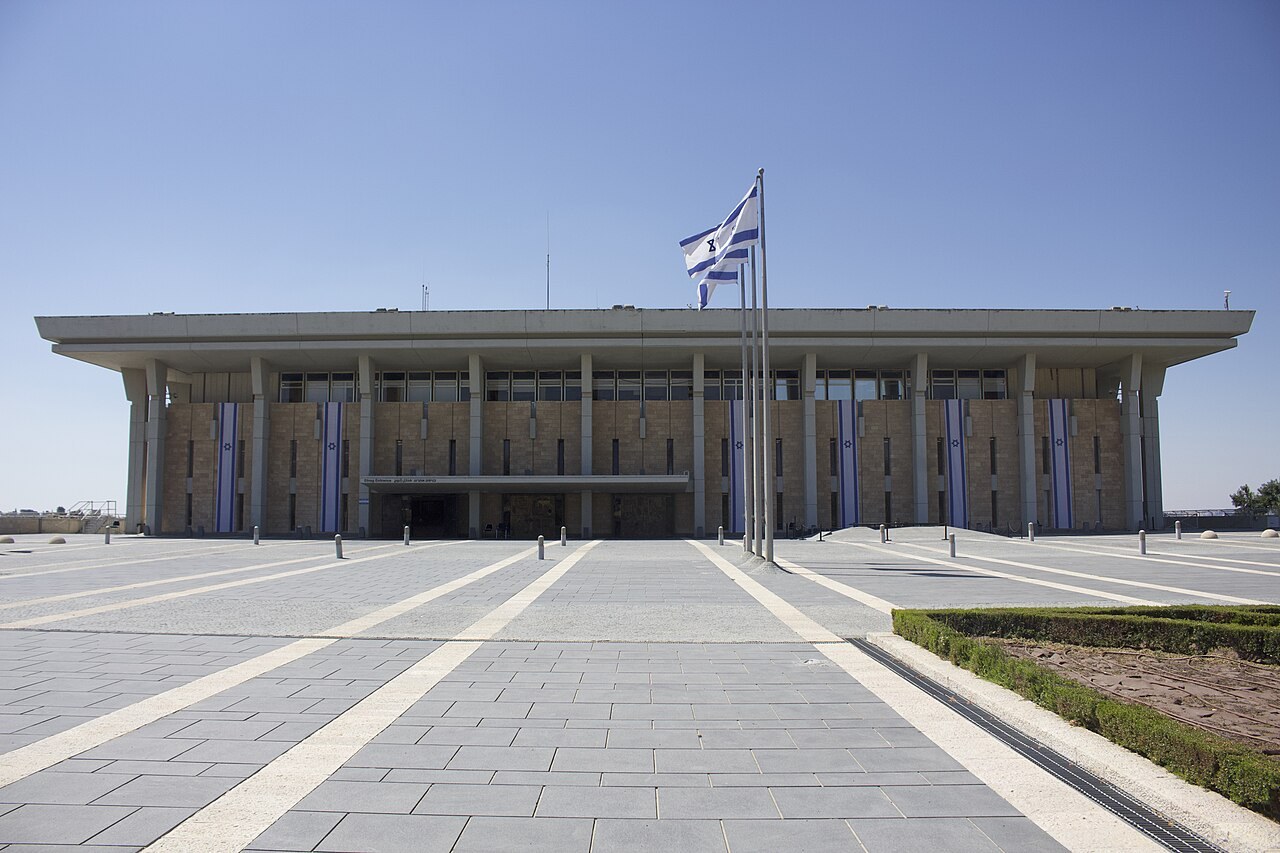
The Knesset in Jerusalem, for which Israelis vote on 27 October 2026; the AI disclosure rules governing the campaign were issued by the Central Elections Committee on 26 July. Illustrative.
Photo: Clema12, CC BY-SA 4.0 · source
Israel votes for the 26th Knesset on Tuesday 27 October 2026 with an artificial-intelligence disclosure regime on the books and little decided under it. The Central Elections Committee, chaired by Supreme Court Deputy President Justice Noam Sohlberg, issued rules on 26 July 2026 requiring election propaganda created or materially altered by digital means to carry a prominent label. Three months on it has ordered two AI videos down on older grounds, rejected two petitions against a third and left a fourth at an interim order — nothing under the new duty itself. The closing week’s only state action on AI content came from elsewhere: on 22 October the Israel Security Agency, the Shin Bet, said it had removed social-media accounts tied to possible foreign influence over the vote.
What the July rules require, and what they leave out
The rules as gazetted, made under section 2A2(b) of the Elections (Propaganda Methods) Law, 5719-1959, set out how the disclosure duty in section 2A2(a) is satisfied. A publisher attaches a written notice or one of two symbols, one for content wholly or mainly digital in origin, the other for material alteration. The size rule turns on the medium: 10 points or 5 per cent of the content’s height in print and still images; a twentieth of the frame, held for the whole clip, in video; spoken at the start and the end in audio. Compliance is presumed to satisfy the duty, which rests on a temporary provision lapsing a year after polling day, as AI & GPP noted in setting out Israel’s first deepfake disclosure rules.
Two removals, and neither of them under the new duty
The committee’s rulings on AI-made content this cycle:
| Date | Matter before the committee | What it decided | What it rested on, and what followed |
|---|---|---|---|
| 26 July 2026 | Disclosure framework under s. 2A2(b) | Written notice or one of two symbols on AI-made or materially altered propaganda; size and placement set by medium | A framework, not a case; the provision behind it is temporary |
| 26 July 2026 | Religious Zionism (Smotrich) video of Eisenkot with Mahmoud Abbas, partly AI-made, posted 23 June | Removal from the party’s and Smotrich’s accounts; end-of-clip label held not prominent enough | s. 13, unfair interference — the clip predated the disclosure duty. Removed, then reposted the next day with an AI tag |
| 6 August 2026 (reported) | Yashar (Eisenkot) campaign video using AI-made images of IDF soldiers | Removal ordered on Likud’s petition | Use of public assets, not AI; the IDF-propaganda ban postdated the clip |
| 1 October 2026 | Two petitions against a Religious Zionism video showing Justice Yitzhak Amit dragged away by police, with the attorney general also shown | Both rejected; absent legal grounds, the video was for the voter to judge, not election law | None — no order made |
| 4 October 2026 | Six Netanyahu speech videos | Five breaches of propaganda law; removal or partial removal; NIS 29,000 in costs paid personally | Public resources, not AI — enforced |
| 15 October 2026 | Yashar (Eisenkot) altered video of Netanyahu “congratulating” Yahya Sinwar | Interim order: label the clip as digitally made or edited, or remove it | No final ruling found in the public record as of 25 October |
Neither removal turned on the new duty. The 26 July order against Religious Zionism rested on section 13 of the same law — unfair interference with another party’s propaganda — because the clip had gone up on 23 June, before the duty could reach it; Sohlberg held the end-of-clip label did not remove the risk of misleading viewers, Israel Hayom reported. The party put it back the next day carrying an AI tag, with no further committee action reported. The August order against Yashar turned on public assets, as The Seventh Eye also reported. Three months on, the duty itself has not decided a case.
Why the closing week’s only state action on AI content came from the Shin Bet
On 22 October the Shin Bet said it had deleted accounts whose activity could open the election to foreign influence, as the Times of Israel also reported. Yonah Jeremy Bob reported for the Jerusalem Post that the statement named no number, no platform and no state, though officials have pointed to Russia, Iran and China over earlier elections, and that Netanyahu said the day before that Iran and its proxies had weighed ways to sway the vote.
Two days before polling, on 25 October, Netanyahu shared on his X account an AI-generated image of a nuclear explosion over Tel Aviv, the Times of Israel reported; the report does not say whether the post carried a label and records no petition or committee action on it by that evening.
Allegations run the other way. Al Jazeera, summarising a Haaretz report, says dozens of bot accounts built to undermine Iran’s government have been turned to pushing pro-Netanyahu material and warning voters against Eisenkot and Naftali Bennett. It has Likud dropping Elector, a turnout-tracking app the committee restricted on privacy grounds, for one called Victory 26, whose launch the Times of Israel reported on 18 October, which it says hides voters’ identities while showing activists where turnout is lowest — though it also has activists noting by hand who has voted. Both rest on Al Jazeera, the first on Haaretz through it.
The exposure the rules do not reach
The Times of Israel’s Ariela Karmel reported on 19 October that policing fakes leaves the larger exposure untouched: voters who ask a chatbot. Shay Hershkovitz, an adjunct professor at Georgetown University, told the paper: “It’s not the fake video you see, it’s the AI system you trust.” An Israel Internet Association survey in May put ChatGPT use among Israeli adults at 88 per cent and Gemini at 73 per cent; Tehilla Shwartz Altshuler of the Israel Democracy Institute tells the paper that generative engine optimisation — shaping what a model retrieves and repeats — will decide the election. Neither expects AI video to move votes: Hershkovitz cites studies of the 2024 British, French and European votes that found no sign of a changed result, and Shwartz Altshuler argues public campaigning mainly makes noise.
The framework polices what a campaign publishes. Nothing in it reaches what a chatbot tells a voter.
Others have pushed further. AI & GPP reported that Brazil’s electoral court ordered Meta to treat both run-off candidates identically, with any automated restriction reviewed by a person within two hours and a daily fine of R$500,000; South Africa instead routes suspected disinformation through a reporting mechanism. Israel sits between: a labelling duty with a judge attached, and nothing aimed at distribution.
A disclosure rule is quick to write, slow to adjudicate and silent on the channel a growing share of voters use. Three things to watch after Tuesday: whether the Yashar matter draws a final ruling, since the duty has a year left to run; whether Victory 26 draws a petition; and whether the next jurisdiction to copy Israel’s framework copies its blind spot. AI & GPP’s look-ahead of 19 October framed the test. It is still open.
Sources
- Shin Bet announces it removed social media accounts trying to interfere with elections — The Jerusalem Post, 22 October 2026
- Bots, deepfakes and surveillance: Israel’s election goes to war online — Al Jazeera, 25 October 2026
- Elections panel orders Yashar to change or remove digitally altered video of Netanyahu congratulating Sinwar — The Times of Israel, 15 October 2026 (liveblog entry)
- Election panel orders Netanyahu to remove videos that violate propaganda laws — The Times of Israel, 4 October 2026
- Policing only deepfakes, Israel leaves chatbot-trusting voters exposed to real AI threat — The Times of Israel, 19 October 2026
- PM posts AI image of nuke hitting Tel Aviv, warns of ‘2nd Holocaust’ if he’s not elected — The Times of Israel, 25 October 2026
- Sohlberg rejects petitions against Religious Zionism’s AI video — Maariv, 1 October 2026 (in Hebrew; translation by AI & GPP)
- Sohlberg accepts Likud’s petition: orders Eisenkot to remove AI-generated video featuring soldiers — Ynetnews, 6 August 2026
- After Sohlberg’s ruling: Religious Zionism removed the AI video on Eisenkot — and posted it again — Walla, 27 July 2026 (in Hebrew; translation by AI & GPP)
- Sohlberg orders removal of Smotrich’s AI video of Eisenkot with Abbas — Israel Hayom, 26 July 2026 (in Hebrew; translation by AI & GPP)
- Elections (Propaganda Methods) Rules on Compliance with the Disclosure Duty for Election Propaganda That Is a Deepfake, 5786-2026, Kovetz Hatakanot 12484, 26 July 2026 (PDF; in Hebrew; translation by AI & GPP; the gazette text as circulated by law.co.il, the official register on bechirot.gov.il being unreachable)
- Social media profiles part of election ‘foreign influence campaign’ erased from internet — Shin Bet — The Times of Israel, 22 October 2026 (liveblog entry)
- Chair of the Elections Committee rules: the ban on using soldiers in election propaganda also covers AI-generated figures — The Seventh Eye (העין השביעית), 6 August 2026 (in Hebrew; translation by AI & GPP)
- Ex-Likud official warns party app could be used to illegally monitor polling stations — The Times of Israel, 18 October 2026
Discussion
No comments yet. Start the conversation.