The Briefing: Ten Moves That Change What Governments Must Write Down
Brazil's electoral court puts algorithmic reach on a six-hour clock, two AI Act duties fall due on 2 December, Pennsylvania gives advertisers eight weeks, Washington renames AI in its own paperwork, and six more moves from New York to Hobart. The week in ten items.
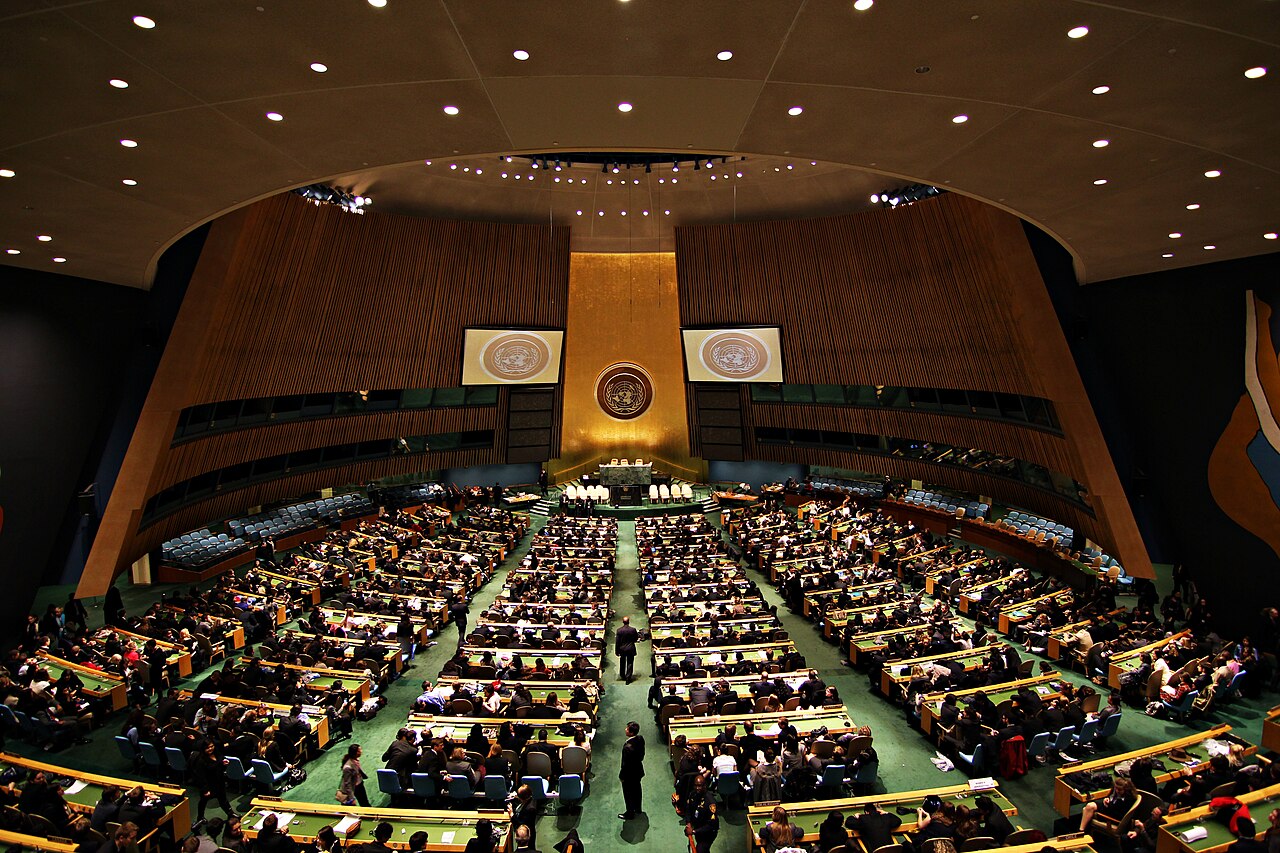
The General Assembly Hall at United Nations headquarters in New York, where two draft resolutions on autonomous weapons and military AI sit before the First Committee (illustrative; photographed in 2011).
Photo: Basil D Soufi, CC BY-SA 3.0 · source
1. Brazil Puts Algorithmic Reach on a Six-Hour Clock
In the forty-eight hours before Brazilians voted in the presidential run-off on 25 October, the
Electoral Inspector-General, Minister Ricardo Villas Bôas Cueva, ordered Meta and X to file reports
every six hours on the reach of posts by the federal deputy Nikolas Ferreira and the candidate Pablo
Marçal — views, where the audience came from and the recommendation mechanisms involved — and a
final report within six hours of the close of voting, on pain of R$500,000 fines, the court
said.
From midnight on 24 October Meta also had to stop recommending the pair’s election-related posts to
non-followers across Instagram, Facebook and Threads, leaving the posts visible to followers; both
orders go to the full court for referendum, and as of 25 October none had been announced. Nothing the
platforms file is public, so the court holds distribution data no party or researcher can read — see
Explain the Algorithm.
By 9:32 pm Brasília, with 99.89 per cent of polling stations counted, the TSE’s totals gave Lula 51.77 per cent to Flávio Bolsonaro’s 48.23 per cent, after a Supreme Court order had extended voting to 7:00 pm where polls had not closed and delayed the count by two hours.
2. Europe’s Rules Arrive on 2 December, Its Enforcers This Week
Two duties under the AI Act become enforceable on 2 December 2026: the prohibition on systems that
generate non-consensual intimate imagery or child sexual abuse material, inserted as Article 5(1)(ba)
and (bb) by Regulation (EU) 2026/1744,
the Digital Omnibus on AI; and machine-readable marking under Article 50(2) for generative systems
already on the market before 2 August 2026. The less-noticed change decides who knocks: the Omnibus
rewrote Article 75(1) so that, since 2 August 2026, the AI Office in Brussels — not a national
regulator — is exclusively competent for providers of systems built into a platform or search engine
designated under the Digital Services Act, and for same-undertaking general-purpose systems, subject
to four carve-outs. Europe’s Deepfake Deadline Is 2
December sets
out which counterparty applies to what.
The bodies that will do the knocking are only now in place. Italy’s decreto legislativo 7 ottobre
2026, n. 179, published in Gazzetta
Ufficiale n. 234 of 8 October 2026 and in force since 23 October, designates AgID and ACN as the
national AI authorities — AgID as the notifying authority, ACN among those for market surveillance
(in Italian). Poland’s Commission for the Development and Security of Artificial Intelligence takes
complaint and inspection powers on 28 October under Article 59(1) of the ustawa z dnia 3 lipca
2026 r. o systemach sztucznej inteligencji (Dz.U. poz. 1003), as AI & GPP set out last
week — but on 25 October
its complaints page still marked the electronic form
“w trakcie opracowania”, in preparation with no opening date (in Polish).
3. Pennsylvania Gives Advertisers Eight Weeks
Governor Josh Shapiro approved 58 bills on 22 October, among them Senate Bill 806, now Act No. 99
of 2026, the Artificial Intelligence Deceptive
Advertising Act. It takes effect on 21 December 2026, reaches synthetic content of any kind — image,
video, audio clip or text significantly modified or generated by AI — where its use creates a false
consumer perception about the nature, origin or authenticity of what is advertised, and carries no
knowledge requirement: a Senate floor amendment adopted 48–2 on 10 June struck the words “knowingly,
recklessly or willfully” from the disclosure duty. Enforcement runs only through the Attorney General
or a district attorney, and the fine stops at $3,000, which is why labelling is the cheaper
default.
4. The FCC’s Robocall Waiver Is Still Open
The Federal Communications Commission has taken comment on a Club for Growth petition to waive the
rules barring artificial and prerecorded voices in unsolicited calls to mobile phones. The reply-comment period closed on 19 October, the day ITIF filed reply comments urging denial, and the commission could rule as soon as late October,
the Associated Press reported,
with the American midterms on 3 November. It is the one regulator in this issue moving towards
permission rather than disclosure, a contrast drawn out in the Brazil
piece and traced
earlier in Robocalls, Deepfakes and the Parody
Defence.
5. Washington Renames AI in Its Own Paperwork
A department-wide State Department cable obtained by Nextgov/FCW,
which reported it on 20 October, instructs that official titles and programme and system names “must
use SI in place of AI”, with carve-outs for statutory language, contracts and already-published
titles — the department’s international organisations bureau had made the switch in September, the Associated Press reported; the context is Executive Order 14434 of 29 September directing agencies to adopt the term. The
practical consequence for a non-American buyer is dull and real: document registers and contract
definitions written against “artificial intelligence” will start missing American source material —
a shift visible in the week’s NIST, NSA and CISA key practices, as this week’s cover
story
sets out.
6. The Sponsor Lists Are the News in New York
Two draft resolutions sit before the General Assembly’s First Committee, both dated 13 October.
A/C.1/81/L.37, with 21
sponsors printed on it, calls on the parties to the Convention on Certain Conventional Weapons to
“advance to negotiations on an instrument” on lethal autonomous weapons;
A/C.1/81/L.34, with 47,
asks instead for structured dialogues in Geneva in 2027 and 2028. France and the United Kingdom back
the dialogue text and not the negotiating one; China, Russia and the United States sponsor neither.
Both are non-binding whatever the vote, and the only venue that could adopt a negotiating mandate is
the CCW Review Conference in Geneva from 16 to 20 November — the arithmetic is
here.
7. Pakistan Announces a Model It Has Not Tendered
Pakistan’s Federal Minister for IT and Telecommunication, Shaza Fatima Khawaja, told a World Bank
summit panel in Seoul that her government is building a state-backed model called Buraq for Urdu and
Pakistan’s regional languages, and is buying sovereign compute so that Pakistani data is processed at
home, the Express Tribune reported
on 22 October from a Ministry of IT statement. Neither announcement came with a builder, a
specification, a procurement notice or a date, and neither appears in the ministry’s own account of
the keynote,
which carries the $1bn AI commitment to 2030 but not Buraq. What each claim rests
on.
8. South Africa Has 700 Complaints and No Court Case
Nine days before municipal elections on 4 November, the Chief Electoral Officer, Sy Mamabolo, said
the Electoral Commission had received more than 700 complaints about election-related disinformation,
most linked to posts on X and some involving AI used to alter people’s photographs, and that none of
it had significantly disrupted the election environment, SAnews
reported on 20 October. The gazetted disinformation code binds
only parties, candidates and their agents; sanction runs through the Electoral Court, which can fine
up to R200,000 or cancel a party’s registration, and no disinformation referral has been reported.
The platform most complained about is not among the four the Commission has enlisted — the gap is
architectural.
9. Morocco Gives AI a Minister
On 16 October King Mohammed VI appointed a new
government in which
Ahmed Rahhou holds a ministry for artificial intelligence, digital transformation and administration
reform, a new portfolio, Le Matin noted — the first time the subject has had a named owner at cabinet rank in Rabat. It is the
opposite of the problem next door: Egypt’s one-year window to comply with its data-protection
regulations closes this week on a date nobody can establish, because the decree that started the
clock is not public. Egypt’s Grace Period
Ends sets out the four
published readings of one deadline.
10. Australia’s Data Centres Wait on Poles and Councils
Two AI data-centre projects stalled in the same week on electricity and local consent, and neither
wall was built in Canberra. Hydro Tasmania told a state committee in
writing
that “no decision has been made” on the roughly 444MW Firmus Technologies has proposed across three
Tasmanian sites, with its assessment due by the end of calendar 2026; in Victoria, NEXTDC cut FY27
net revenue guidance to A$475m–500m from A$615m–640m after Jemena suspended the network upgrade its
West Footscray campus needs, telling the
ASX that works will not
resume before February 2027. Not one project in this
week’s survey
waits on an artificial-intelligence rule.
Sources
- Corregedor do TSE determina que Meta e X apresentem relatórios a cada seis horas sobre publicações de Nikolas e Marçal — Tribunal Superior Eleitoral, 24 October 2026 (decision of 23 October 2026; in Portuguese; translation by AI & GPP)
- Regulation (EU) 2026/1744 of the European Parliament and of the Council of 8 July 2026 amending Regulations (EU) 2024/1689, (EU) 2018/1139 and (EU) 2023/1230 as regards the simplification of the implementation of harmonised rules on artificial intelligence (Digital Omnibus on AI) — EUR-Lex, Official Journal of the European Union, 24 July 2026
- Decreto legislativo 7 ottobre 2026, n. 179 — Gazzetta Ufficiale n. 234, via Normattiva, 8 October 2026 (in Italian; translation by AI & GPP)
- Skargi — Komisja Rozwoju i Bezpieczeństwa Sztucznej Inteligencji (KRiBSI), gov.pl, accessed 25 October 2026 (in Polish; translation by AI & GPP)
- Senate Bill 806, Regular Session 2025-2026 — Pennsylvania General Assembly, last action “Act No. 99 of 2026, Oct. 22, 2026” (accessed 25 October 2026)
- Reply Comments to the FCC Regarding the Club for Growth’s Petition for an Expedited TCPA Waiver — Information Technology and Innovation Foundation, 19 October 2026
- FCC considers allowing more political robocalls before midterms, including those created with AI — Associated Press, via WCAX, 7 October 2026
- State Department orders ‘super intelligence’ wording across all official communications — Nextgov/FCW, 20 October 2026
- US diplomats told to say ‘super intelligence’ — not ‘artificial intelligence’ — after Trump’s call — The Associated Press, 23 September 2026
- Inaugurating the Era of Super Intelligence, Executive Order 14434 — The White House, 29 September 2026
- A/C.1/81/L.37, “Lethal autonomous weapons systems: draft resolution” — United Nations General Assembly, First Committee, 13 October 2026 (PDF)
- A/C.1/81/L.34, “Artificial intelligence in the military domain and its implications for international peace and security: draft resolution” — United Nations General Assembly, First Committee, 13 October 2026 (PDF)
- Urdu AI model Buraq to keep data at home — The Express Tribune, 22 October 2026
- Federal Minister Shaza Fatima Khawaja delivers keynote address at “Global AI & Digital Summit” in South Korea, Seoul — Ministry of Information Technology and Telecommunication, Government of Pakistan, 19 October 2026
- IEC enters into partnership to counter disinformation — SAnews (South African Government News Agency), 20 October 2026
- HM the King chairs new government appointment ceremony — Maroc.ma (Kingdom of Morocco official portal), 16 October 2026
- Qui est Ahmed Rahhou, ministre de l’Intelligence artificielle, de la Transformation numérique et de la Réforme de l’administration ? — Le Matin, 16 October 2026 (in French; translation by AI & GPP)
- Submission No. 11, Hydro Tasmania — Joint Select Committee on Energy Matters, Parliament of Tasmania, 22 September 2026 (PDF)
- M3 Melbourne Power Delay and Revised FY27 Guidance — NEXTDC Limited, ASX announcement, 21 October 2026 (PDF)
- Resultados — Tribunal Superior Eleitoral (2º Turno, Eleição Geral, 25/10/2026), accessed 9:32 pm Brasília, 25 October 2026 (in Portuguese)
- Esclarecimento sobre prorrogação da votação — Tribunal Superior Eleitoral, 25 October 2026 (in Portuguese; translation by AI & GPP)
Discussion
No comments yet. Start the conversation.