The Briefing: Newsom Signs, Rivals Lawyer Up, Denmark Guards Faces
California signs 13 AI bills, US candidates take deepfakes to lawyers and the police, Brazil argues over gas for data centres, Denmark moves to protect faces and voices, and South Australia opens a royal commission into AI.
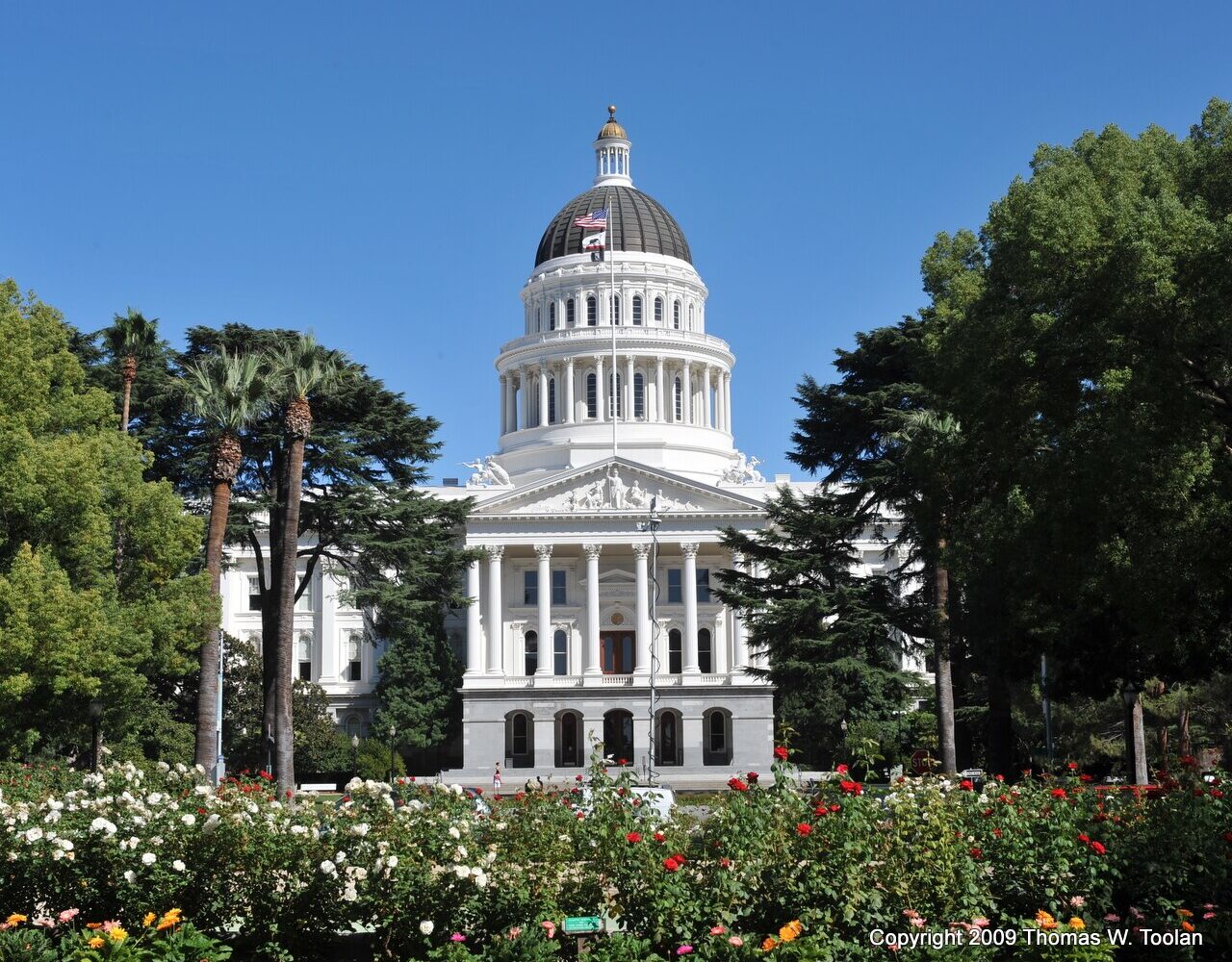
The California State Capitol in Sacramento; Governor Newsom's office announced the signing of 13 AI bills from Sacramento on 30 September (illustrative; photographed 2009).
Photo: Ttoolan, CC BY-SA 3.0 · source
Most of this week’s AI rule-making came from governors, electoral bodies, ministries and prosecutors rather than national parliaments. Across ten items the same three questions recur: who must disclose synthetic content, who answers when it harms someone, and what a data centre must give back for its tax breaks.
1. California: Newsom Signs 13 AI Bills and Vetoes Two
Governor Gavin Newsom signed 13 AI-related bills on 30 September, his office announced. SB 947 stops employers relying solely on AI to discipline or dismiss staff; SB 951 requires notice of AI-caused mass layoffs; AB 1883 bars inferring workers’ emotions or collecting brain data; AB 1979 leaves the final say on patient care with health professionals; two bills amend the California AI Transparency Act. He vetoed two health-worker bills, and SB 947 was weakened in passage, CalMatters reported. Utah’s governor signed a “pro-human” AI executive order for state agencies, his office announced on 6 October; Oregon’s Executive Order 26-26 of 23 September, Governor Tina Kotek’s office said, has the state CIO draft third-party AI safety-review standards and study a frontier-model “kill switch”.
Why it matters The working rules for AI in the workplace are being written state by state, the pattern traced in this desk’s California v Washington. Employers operating across state lines should map the obligations now rather than wait for Congress.
2. United States: Midterm Deepfakes Draw Legal Threats
Lawyers for Rebecca Cooke, the Democrat challenging Representative Derrick Van Orden in Wisconsin’s 3rd district, sent him a cease-and-desist letter on 30 September over AI videos on his X account that show her saying things she never said, arguing they risk defamation, WPR reported. Van Orden’s campaign accused Cooke of a tantrum; he answered with another AI clip. In Texas, Vikki Goodwin, the Democratic state representative running for lieutenant governor, filed a report with the Travis County Sheriff’s Office on 19 September alleging that Lieutenant Governor Dan Patrick’s AI ads, which she says put words in her mouth, broke a 2019 state election law, KUT reported; Patrick’s campaign calls the ads parody released outside the law’s 30-day window. Patrick’s campaign later removed the ads, and Van Orden’s team did not respond to Axios’s request for comment, Axios reported; it described both disputes as early legal challenges that could move to the courts.
Why it matters Where statutes are thin or untested, campaigns are turning to defamation threats and criminal complaints, a shift from the ad tallies in this desk’s Slopaganda. A first ruling on where parody ends and deception begins would set the working rule faster than any legislature.
3. Brazil: A Data-Centre Tax Break Waits on a Definition of “Low-Emission”
Lei nº 15.504, signed on 15 September, creates Redata, a special tax regime for data centres that suspends PIS/Pasep, Cofins, IPI and import tax on qualifying equipment. In return, beneficiaries must offer at least 10 per cent of capacity to the domestic market, source all their electricity from renewable or low-emission generation, keep water-usage effectiveness at or below 0.05 L/kWh and invest 2 per cent of the products’ value in research and innovation in Brazil. Defining low-emission was left to an interministerial ordinance, Poder360 reported. The Mines and Energy Ministry wants natural gas included and the Finance Ministry objects; gas producers have lobbied the Industry Ministry, CNN Brasil reported.
Why it matters The ordinance will decide whether gas-fired campuses can claim the incentive, and so what kind of data-centre build-out Brazil subsidises. Investors weighing sites should treat the energy condition as open until it is published.
4. Mexico: Child Deepfakes Banned, Wider AI Rules Missing
Mexico’s National Electoral Institute (INE) amended its guidelines on electoral propaganda on 3 September to protect children and adolescents, banning deepfakes and making AI use subject to guardians’ explicit consent, the institute’s news service reported. Broader rules are absent. According to Índice Político, a proposal in President Claudia Sheinbaum’s March electoral reform to label AI-altered electoral content did not make the final initiative; Sheinbaum has since asked the INE to define rules for social-media propaganda, and electoral officials told the outlet the institute has until precampaigns open in January 2027 to issue AI guidelines.
Why it matters Mexico may enter its 2027 elections with AI rules written by an administrative body rather than Congress, the federal gap examined in Mexico Wants One AI Law. Parties should plan for guidelines arriving late and changing mid-cycle.
5. Denmark: A Copyright Claim to Your Own Face and Voice
Culture Minister Zenia Stampe introduced a bill on 8 October amending the Copyright Act so that sharing realistic digital imitations of a person’s appearance or voice without consent becomes unlawful, the Ministry of Culture announced. It covers ordinary people and performers alike and implements a cross-party agreement of June 2025. Satire, parody, caricature and criticism of power stay permitted unless they amount to misinformation posing serious dangers to others, Euronews reported. Stampe said a central aim is getting large platforms to remove manipulated material quickly, and she hopes the law can take effect at the turn of the year.
Why it matters France already bans sharing AI depictions of people without consent and England and Wales have criminalised intimate deepfakes, according to Euronews; Denmark instead treats likeness as a right its holder can enforce. Platforms should expect deepfake takedown demands framed as copyright claims, which they already process at scale.
6. European Union: Member States Edge Towards AI Training on Personal Data
EU ambassadors were due on 7 October to discuss the Council’s position on the data omnibus, which would amend the General Data Protection Regulation (GDPR) and ePrivacy rules, netzpolitik.org reported. According to the outlet, the Irish presidency’s draft of 2 October lets companies rely on legitimate interest rather than consent to train AI on personal data if they meet certain standards, with an Article 21 right to object added in the latest compromise. Spain, Bulgaria, Latvia and Estonia object to the change, and the campaign groups noyb and EDRi have come out against what critics call a blanket permission. This desk could not confirm the outcome of the meeting.
Why it matters If the Council text holds, the legal basis for training models on Europeans’ data goes into trilogue negotiations with the European Parliament. It runs alongside the AI Act timetable changes set out in Europe Resets the Clock on the AI Act.
7. Middle East and North Africa: The World Bank Sees Augmentation, Not Mass Layoffs
The World Bank’s October update for the Middle East, North Africa, Afghanistan and Pakistan, From Divide to Opportunity: AI, Jobs, and Growth, finds AI more likely to lift productivity than to destroy jobs: fewer than 10 per cent of jobs face near-term automation risk, while 13–20 per cent carry significant augmentation potential, the Bank said on 6 October. It flags a localisation gap: Arabic, spoken by more than 500m people, accounts for about 0.7 per cent of global URLs. The backdrop is harsh: after the closure of the Strait of Hormuz, the Bank expects GCC economies to shrink by 4.3 per cent in 2026.
Why it matters Read with this issue’s World Bank analysis of South Asia’s AI jobs exposure, both of the Bank’s regional updates frame AI’s labour-market effect as a question of skills and complementarity rather than mass job losses. The MENA report adds a language-data gap that ministries funding Arabic datasets can address directly.
8. South Australia: A Royal Commission Into AI Starts Work
South Australia’s Royal Commission into Artificial Intelligence began work on 1 October, chaired by Dr Iain Ross AO, a former Federal Court judge, with former Tech Council of Australia chief executive Kate Pounder and Stanford University’s Professor Christopher Manning, ABC News reported; its report is due by 1 July 2027. The terms of reference cover productivity, jobs and workplace practices, education, the policy and legislative frameworks the state needs, and AI in public services including health. Data centres and Commonwealth matters such as national security and copyright are excluded.
Why it matters A royal commission led by a former judge carries more weight than a consultation paper. In this desk’s reading, its labour-market findings are likely to reach Canberra’s agenda well before mid-2027.
9. United States: A $300m Server-Smuggling Case
Greg Lui, 38, owner of Earthmade Computer Inc., was arrested on 1 October on a three-count indictment returned on 29 September, the Justice Department said. He is charged with conspiring to violate export-control law, outbound smuggling and conspiring to launder money over more than $300m of servers with export-controlled GPUs that prosecutors allege were shipped via Malaysia and Singapore to China. According to the department, Earthmade received more than $176m from two Malaysia-based shipment companies between January and October 2024. The Register reported that the hardware included Nvidia A100 and H100 chips. The charges are allegations; Lui is presumed innocent.
Why it matters Transshipment hubs remain the weak point in chip controls, the enforcement front of the rivalry described in Two Blocs, One Technology. Transit states will face more pressure to police re-exports themselves.
10. Global: Region Watch, Bangkok
The IMF and World Bank Annual Meetings run in Bangkok from 12 to 18 October, according to the IMF. The Fund’s schedule puts the World Economic Outlook briefing on 13 October and the Fiscal Monitor on 14 October. AI sessions include a New Economy Forum session, “Rethinking Taxation for the AI Era”, on 14 October, a session on tokenisation and agentic AI in financial infrastructure on 13 October, and “AI and the Global Economy” on 16 October.
Why it matters IMF Managing Director Kristalina Georgieva’s preview speech, covered in the previous Briefing, framed AI as a source of extra growth; the Bangkok programme also asks finance ministers how to tax it. Watch the Fiscal Monitor for any guidance on taxing AI-driven profits.
Sources
- California’s nation-leading AI framework just got stronger, Governor Newsom signs more first-in-the-nation worker protections and more — Governor of California — 30 September 2026
- On AI, Newsom gives labor only some of what it demanded — CalMatters — September 30, 2026 (updated October 1, 2026)
- News release: Gov. Cox signs executive order establishing Utah’s pro-human approach to AI in state government — Office of the Governor of Utah — October 6, 2026
- Governor Kotek issues executive order to advance AI safety and oversight — Office of the Governor of Oregon — September 23, 2026
- The AI deepfake election is starting to get litigious — Axios — October 2, 2026
- Cooke campaign sends cease-and-desist to Congressman Van Orden over AI deepfakes — WPR — October 1, 2026
- Vikki Goodwin files police report saying Dan Patrick broke law with AI-generated campaign ads — KUT — September 21, 2026
- Lei nº 15.504, de 15 de setembro de 2026 — Presidência da República (Planalto) — 15 September 2026; (in Portuguese; translation by AI & GPP)
- Política para data centers deixa de fora regra sobre fontes de energia — Poder360 — 15 de setembro de 2026; (in Portuguese; translation by AI & GPP)
- Setor de gás natural teme exclusão do Redata e se mobiliza por decreto — CNN Brasil — 28/09/26; (in Portuguese; translation by AI & GPP)
- INE modifica lineamientos para proteger a infancias contra mal uso de IA y deepfakes — Central Electoral, Instituto Nacional Electoral — septiembre 3, 2026; (in Spanish; translation by AI & GPP)
- Elección de 2027 enfrentaría deepfakes y propaganda digital sin reglas específicas — Índice Político — 27 de septiembre de 2026; (in Spanish; translation by AI & GPP)
- Kulturminister vil dæmme op for delinger af digitale efterligninger fra årsskiftet — Kulturministeriet — 08.10.2026; (in Danish; translation by AI & GPP)
- Denmark introduces bill to protect people’s faces and voices from deepfakes — Euronews — 08/10/2026
- Einigung absehbar: EU-Staaten entscheiden über Cookie-Banner, KI-Training und Co. — netzpolitik.org — 6. Oktober 2026; (in German; translation by AI & GPP)
- Middle East, North Africa, Afghanistan & Pakistan Economic Update — October 2026: From Divide to Opportunity: AI, Jobs, and Growth — World Bank — October 2026
- Middle East conflict further weakens regional outlook, with Gulf oil exporters hit — World Bank press release — October 6, 2026
- SA Premier announces three experts to lead Royal Commission into AI — ABC News — Thu 1 Oct 2026
- Terms of Reference — Royal Commission into Artificial Intelligence (South Australia) — undated; accessed 11 October 2026
- California man arrested for smuggling more than $300 million in export-controlled computer servers to China — US Department of Justice, Office of Public Affairs — Thursday, October 1, 2026
- Californian accused of shipping $300M worth of Nvidia chips to China without Uncle Sam’s approval — The Register — Fri 2 Oct 2026
- 2026 Annual Meetings schedule — International Monetary Fund — undated; accessed 11 October 2026
- 2026 Annual Meetings, Bangkok, Thailand — International Monetary Fund — undated; accessed 11 October 2026
Discussion
No comments yet. Start the conversation.