Pennsylvania Makes Advertisers Confess Their AI
Act 99 of 2026 gives Pennsylvania advertisers eight weeks to disclose AI-made images, audio and video that could mislead consumers, with no knowledge defence. Colorado, meanwhile, is writing its AI rules through a regulator — and its only hearing is on Monday.
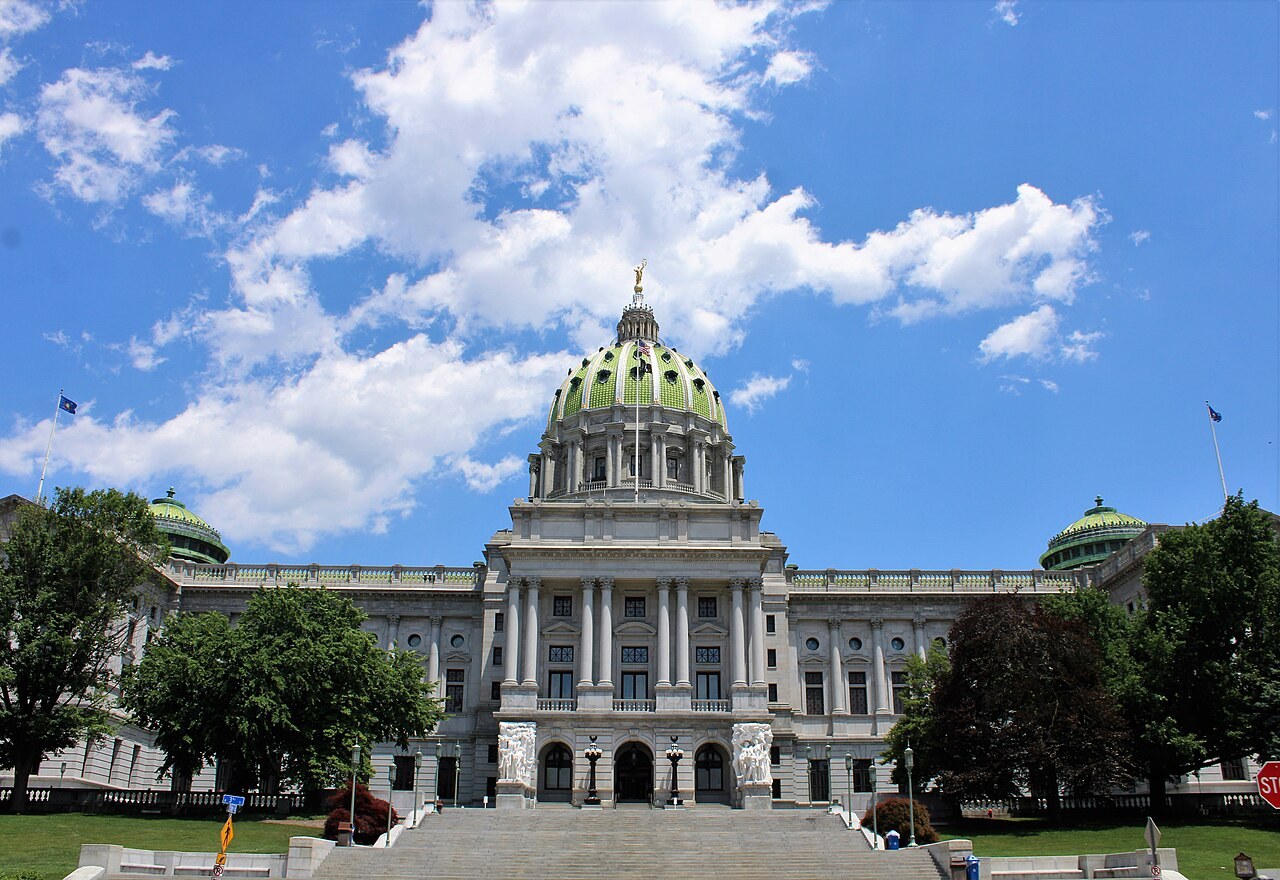
The Pennsylvania State Capitol in Harrisburg, where Senate Bill 806 passed both chambers before becoming Act No. 99 of 2026. Illustrative.
Photo: Farragutful, CC BY-SA 4.0 · source
Key points
- Pennsylvania’s Artificial Intelligence Deceptive Advertising Act, Act No. 99 of 2026, was approved on 22 October 2026 and takes effect on 21 December 2026, carrying a civil fine of up to $3,000 enforceable only by the Attorney General or a district attorney.
- A Senate floor amendment adopted 48–2 on 10 June 2026 struck the words “knowingly, recklessly or willfully” from the disclosure duty, leaving Pennsylvania with no knowledge requirement, unlike New York, whose law applies only where the advertiser has actual knowledge.
- Colorado’s parallel rules under the Automated Decision-Making Technology Act and the Chatbot Safety Act go to a public hearing on 26 October 2026, and the Department of Law’s regulatory analysis of 21 October puts no dollar figure on compliance.
On 22 October 2026 Governor Josh Shapiro approved 58 bills in a single day. One of them changes what any company advertising into Pennsylvania may put on a screen. Senate Bill 806, printed as Printer’s No. 1808 and now Act No. 99 of 2026, is the Artificial Intelligence Deceptive Advertising Act. It takes effect in 60 days — on 21 December 2026, eight weeks from Monday. Pennsylvania becomes the third American state to write an AI-disclosure duty into advertising law, after New York and California, and the only one that reaches synthetic content of any kind rather than digital stand-ins for human performers.
The Governor’s office recorded 58 bills, 30 House and 28 Senate, and listed SB 806 without comment; City & State Pennsylvania reported the prime sponsor, Senator Nick Pisciottano, describing it in a statement as a “major step for consumer protection in Pennsylvania”, the line first issued in his caucus’s release on final passage. The detail that matters to a general counsel is a line of struck-through type on page three.
The three words that came out on the Senate floor
The version reported by the Senate Communications and Technology Committee in May 2026 would have caught only an advertiser who acted “knowingly, recklessly or willfully”. On 10 June 2026 the Senate adopted amendment A-3593, offered by Pisciottano, by 48 votes to 2; the printed text of PN 1808 carries those three words struck through at Section 4(a). The bill passed the Senate 48–2 the same day, and the House 163–40 on 7 October, having rejected amendments A04520 and A04522 the day before, each 100–103. Because neither carried, no Senate concurrence was needed: the text presented on 21 October was the text the Senate sent in June.
What is left is a flat prohibition. An advertiser may not create and disseminate — or “cause to be created and disseminated” — an advertisement using synthetic content in a way that “creates a false consumer perception about the nature, origin or authenticity of the goods or services being advertised”, absent a clear and conspicuous disclosure. Intent, recklessness and wilfulness have all dropped out. So has the agency defence: a brand that commissioned the work is caught by that second limb whether or not its brief mentioned AI.
A disclosure duty with no knowledge element does not ask what the advertiser meant. It asks what the consumer saw.
What Act 99 forbids, and the trap in the text-only carve-out
The definitions do most of the work. “Synthetic content” is information — “including an image, video, audio clip or text” — that has been “significantly modified or generated by artificial intelligence”. Neither “significantly” nor “false” is defined. The disclosure must state that the advertisement contains content “modified or generated using artificial intelligence”; it must appear in the first instance whenever that content reaches the consumer, in the same medium, and, where technically feasible, be permanent or extraordinarily difficult to remove. “Clear and conspicuous” is itself defined down to volume, cadence, on-screen duration and print type size.
Section 4(b) carves out three categories: content evidently fictional on its face or in context; parody, satire, commentary or criticism; and content “limited to text”. The last is narrower than it looks. Text sits inside the definition of synthetic content and is exempt only where the content is limited to text, so an AI-written line of copy over an AI-generated product shot is not text-only. The parody carve-out imports the problem AI & GPP examined in the parody defence running through America’s deepfake rules: the advertiser decides first whether its own work is commentary, and a district attorney decides second.
Two provisions belong in the compliance file. Section 4(c) says disclosure “shall not be construed to limit any recourse under law”: a label is no safe harbour, and an advertisement that misleads stays exposed under Pennsylvania’s existing false-advertising law regardless. Section 5 confines enforcement to the Attorney General and the appropriate district attorney, either of whom may sue for an injunction or start a civil action; the court’s remedies stop at a civil fine of $3,000 together with “actual attorney fees and court costs”. Nothing in the Act gives a consumer a cause of action. Loeb & Loeb, in a note asking what the Act actually covers, reads the false-perception trigger as uncertain enough that many advertisers will simply label AI-generated Pennsylvania content.
Three states, three different things called AI disclosure
New York’s law, Chapter 617 of 2025, signed on 11 December 2025, amends General Business Law § 396-b and reaches only a “synthetic performer” — in the statutory wording, a digitally created asset giving the impression of a human performance “who is not recognizable as any identifiable natural performer” — and only where the advertiser has actual knowledge. California’s Senate Bill 1050, Chapter 246 of the Statutes of 2026, approved on 16 September 2026, adds Article 10, at Section 17610, to Division 7 of the Business and Professions Code and reaches advertisements that “prominently” include a synthetic performer. Both are performer laws. Pennsylvania’s is a content law that does not mention performers. The consequence, as Loeb & Loeb notes, is close to an inversion: an accurate AI spokesperson may escape Pennsylvania’s trigger while falling inside the other two; an AI-altered real person giving a false endorsement may do the reverse.
The table is drawn from the three enacted texts and Colorado’s rulemaking record.
| Pennsylvania, Act 99 of 2026 | New York, Chapter 617 of 2025 | California, Chapter 246 of 2026 | Colorado, rules in draft | |
|---|---|---|---|---|
| What it covers | Advertisements using synthetic content: image, video, audio clip or text significantly modified or generated by AI | Advertisements in which a synthetic performer appears; audio advertisements excluded | Audio, video or audiovisual advertisements that prominently include a synthetic performer | Not advertising: automated decisions in defined covered domains, and conversational AI services |
| Trigger | Use that creates a false perception of the nature, origin or authenticity of goods or services | Producing or creating such an advertisement | Creating and causing publication of such an advertisement | Deploying technology that materially influences a consequential decision; operating a public chatbot |
| Knowledge required | None | Actual knowledge | None stated | Not applicable |
| Who enforces | Attorney General or district attorney only; no private right of action | Civil penalty; no enforcing body named in the text | Treated as a § 17500 violation, enforceable under the § 17200 unfair-competition chapter | Attorney General and district attorneys |
| Penalty | Civil fine not exceeding $3,000; actual attorney fees and court costs | $1,000 first violation; $5,000 each subsequent violation | No separate penalty; unfair-competition remedies | Violation treated as an unfair trade practice under the Consumer Protection Act |
| Compliance date | 21 December 2026 | 9 June 2026 | 1 January 2027 | 1 January 2027 |
The enforcement row is where the money is. Pennsylvania caps the fine at $3,000 and hands the key to public prosecutors; New York sets a fixed tariff; California routes violations into its unfair-competition chapter, the one route carrying a realistic risk of private litigation, as Manatt noted on signature and as Davis+Gilbert also reads it. New York’s date comes from the Act itself — the 180th day after its 11 December 2025 signature. California’s text sets no commencement date; 1 January 2027 is Manatt’s figure.
In Colorado the rules are being written by the regulator, not the legislature
Colorado is on a different track, and the more instructive one. Two statutes take effect on 1 January 2027: the Automated Decision-Making Technology Act, Senate Bill 26-189, and the Chatbot Safety Act, House Bill 26-1263. Neither is an advertising law. The first governs developers and deployers of technology that materially influences consequential decisions; the second governs operators of conversational AI services, with duties on age estimation, disclosure that the user is talking to a machine, minors’ safety and annual reporting. The detail is being settled not in a chamber but in a rulemaking run by the state Department of Law, which filed draft rules on 11 August 2026, released an interim redline on 6 October and holds its public hearing on Monday 26 October at 10:00 am, 1300 Broadway in Denver, with a Zoom option. Written comments close the same day at 11:59 pm MST.
The economics of that rulemaking are now on the record, and thin. A member of the public asked for a regulatory analysis on 12 October, outside the statutory window; the Department prepared one anyway and published it on 21 October. It contains no dollar figures. Compliance costs “will vary considerably” between entities, it says, and they fall on those entities under the two statutes with or without the rules. The Department found no less costly alternative for the mandatory parts, rejected delay of the discretionary parts as unworkable, and concluded that direct costs to business are outweighed by the benefits. “Inaction is costly to consumers and to the market,” it adds.
That leaves deployers planning against a moving text. The Cloud Security Alliance’s AI Safety Initiative, in a research note of 20 October, warns that the 6 October redline altered several provisions and that notice-timing figures differ between versions, advising organisations to build to the shortest. It also reports, citing the law firm Orrick, that the redline adds a presumption of material influence wherever a human decision-maker reviews a score or ranking and the outcome then matches it — rebuttable only by showing the output was a de minimis factor. For anyone treating a human in the loop as the compliance answer, that is the sentence to read before Monday.
What to do before 21 December, and what to watch on Monday
Three actions are unavoidable in Pennsylvania. Inventory every live and scheduled advertisement with Pennsylvania reach, flagging AI-generated or AI-modified imagery, audio and video, including stock assets and agency deliverables whose provenance nobody has checked. Rewrite the agency and production contracts, because the duty follows whoever caused the content to be created and disseminated. And decide the default: with an undefined trigger and prosecutor-only enforcement, labelling every piece of AI-touched creative is cheaper than being right about the false-perception test — and the label must sit in the same medium, at first exposure, and be hard to strip.
Regulators have a shorter list. The Pennsylvania Attorney General has eight weeks to decide whether to publish guidance on what “significantly modified” and “false consumer perception” mean, or to let the first civil action define them. Monday’s hearing in Denver forecasts what follows: the states suing where Congress will not are now also writing the operating detail, as AI & GPP set out on the attorneys general moving ahead of federal preemption and on the patchwork forming between Sacramento and Washington. Pennsylvania got there with 60 days’ notice and five pages; Colorado is taking a rulemaking and a hearing. Both bind within ten weeks of Monday, and only one can be read in an afternoon.
Questions this answers
Must advertisers label AI-generated advertising in Pennsylvania from 21 December 2026?
Only where synthetic content is used in a way that “creates a false consumer perception about the nature, origin or authenticity of the goods or services being advertised” — but neither “false” nor “significantly modified” is defined in the bill text, and the Senate removed the knowledge standard before passage. With no intent element and no private right of action to bargain against, labelling is the cheaper default than litigating the trigger.
How does Pennsylvania’s law differ from New York’s and California’s?
New York’s Chapter 617 of 2025 and California’s SB 1050 both regulate “synthetic performers” — digital figures standing in for humans — and apply from 9 June 2026 and 1 January 2027. Pennsylvania regulates synthetic content of any kind, including audio and altered footage of real people, and never mentions performers. Enforcement differs as much as scope: Pennsylvania is prosecutor-only with a $3,000 cap, New York sets fixed penalties, and California routes violations into its unfair-competition chapter.
What happens in Colorado on 26 October 2026?
The Colorado Department of Law holds its rulemaking hearing on the Automated Decision-Making Technology Act and Chatbot Safety Act at 10:00 am Mountain Time in Denver, with a Zoom option, and written comments close the same day at 11:59 pm, per the Attorney General’s office. Both statutes take effect on 1 January 2027, and the Department’s regulatory analysis of 21 October contains no dollar figures.
Sources
- Senate Bill 806, Regular Session 2025-2026 — Pennsylvania General Assembly, last action “Act No. 99 of 2026, Oct. 22, 2026” (accessed 25 October 2026)
- Senate Bill 806, Printer’s No. 1808, as amended on third consideration — Pennsylvania General Assembly, 10 June 2026 (PDF)
- Governor Shapiro Signs 58 Bills into Law — Office of Governor Josh Shapiro, 22 October 2026
- 7 bills signed into law by Gov. Josh Shapiro in October — City & State Pennsylvania, 23 October 2026
- A New AI Disclosure Law from Pennsylvania. But What Does It Actually Cover? — Loeb & Loeb, 23 October 2026
- Senate Bill S8420A, 2025-2026 Legislative Session — New York State Senate, signed as Chapter 617, 11 December 2025
- Senate Bill S8420A, bill text — New York State Senate, 2025-2026 session (PDF)
- SB-1050 False advertising: synthetic performers, bill text — California Legislative Information, Chapter 246, approved 16 September 2026
- California Joins New York in Requiring Disclosure of Synthetic Performers in Advertising — Manatt, Phelps & Phillips, 22 September 2026
- Automated Decision-Making Technology Act and Chatbot Safety Act rulemaking — Colorado Attorney General, Colorado Department of Law (accessed 25 October 2026)
- Final Regulatory Analysis, ADMT and Chatbot Safety Act rules — Colorado Department of Law, 21 October 2026 (PDF)
- Colorado’s ADMT and Chatbot Rules: Deployer Readiness — Cloud Security Alliance AI Safety Initiative, 20 October 2026
- Pisciottano’s Landmark AI Bill Establishes One of Nation’s First Advertising Disclosure Standards — Pennsylvania Senate Democrats, 7 October 2026
- California Becomes Second State to Require Disclosure of Synthetic Performers in Advertising — Davis+Gilbert LLP, 18 September 2026
Discussion
No comments yet. Start the conversation.