Europe’s Deepfake Deadline Is 2 December
Two AI Act duties become enforceable on 2 December: the ban on nudification systems, and machine-readable marking for generative systems already on the market. For the biggest platforms the enforcer is Brussels, not a member state.
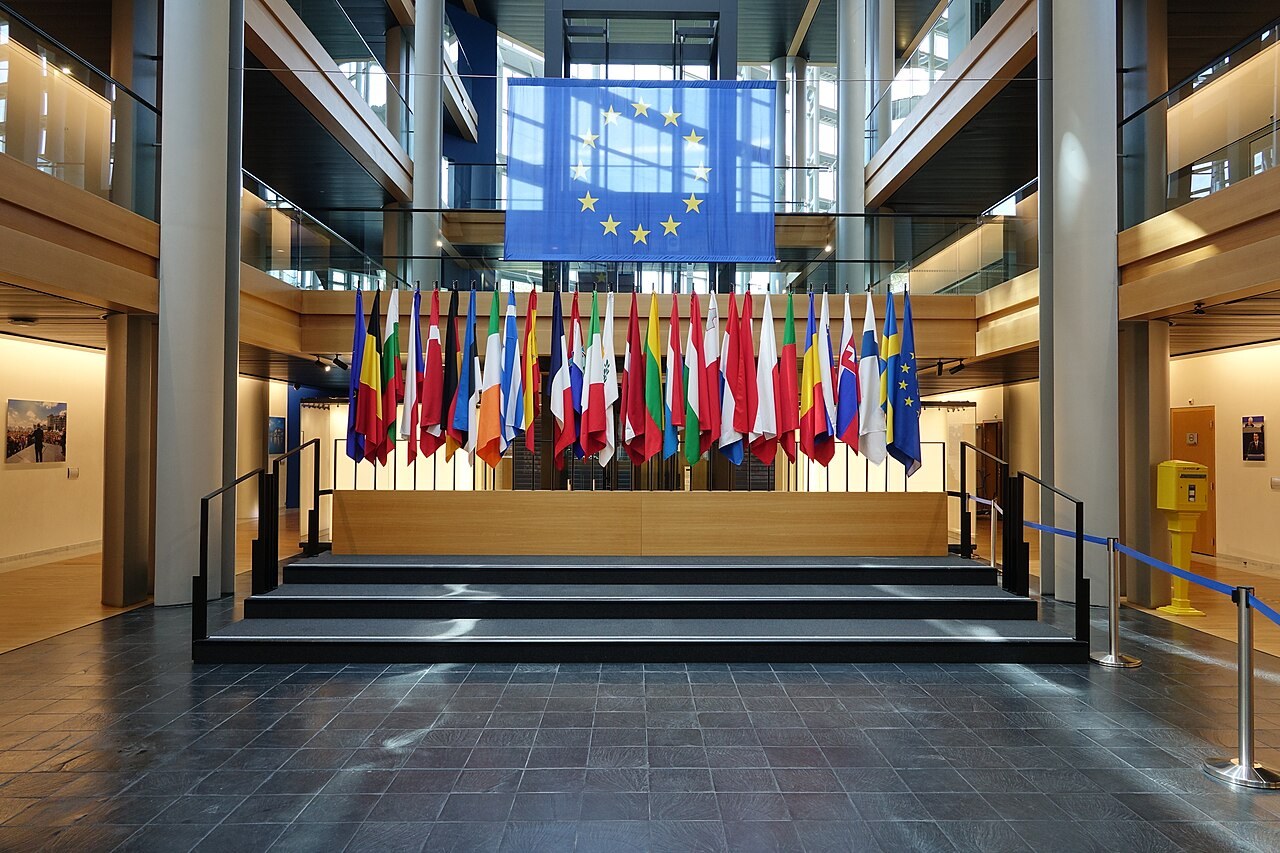
An official area inside the European Parliament in Strasbourg; 119 of its members have asked the Commission to enforce the AI Act’s nudification ban from the day it applies. Illustrative.
Photo: Gzen92, CC BY-SA 4.0 · source
Europe’s rules on synthetic content stop being a drafting question on 2 December 2026. Regulation (EU) 2026/1744, the Digital Omnibus on AI, was adopted on 8 July 2026, carries 24 July on its Official Journal masthead and entered into force on 27 July. It is settled law. Two of its dates fall on 2 December: the ban on systems generating non-consensual intimate imagery, and the marking deadline for older generative systems.
An open letter signed by 119 MEPs — from the Socialists and Democrats, Renew Europe, the Left and the Greens, with the European People’s Party added by EU Perspectives but not EUobserver — asks the Commission and member states to make the nudification ban enforceable, to tighten Digital Services Act enforcement against search engines and the platforms that carry or index such material, and to act faster on the investigation into X and Grok, EU Perspectives reported. Agora Digital Transformation, the think tank whose research prompted the letter, found 50 MEPs, 46 of them women, on sexualised-deepfake sites. The signatories also want a resourced authority in every member state ready for December, EUobserver reported on 5 October. Neither outlet dates the letter.
What 2 December switches on, and what moved back
Article 113 of the AI Act, Regulation (EU) 2024/1689, has its third paragraph rewritten to apply Chapters I and II from 2 February 2025 “with the exception of Article 5(1), first subparagraph, points (ba) and (bb), and Article 5(1a) and (1b) which shall apply from 2 December 2026”. Point (ba) prohibits placing on the market, putting into service or using a system that generates or manipulates realistic material showing an identifiable person’s intimate parts, or that person in sexually explicit activity, without explicit consent; point (bb) covers child sexual abuse material.
The marking duty arrives by another route. A new paragraph 4 of Article 111 gives providers of systems generating synthetic audio, image, video or text — general-purpose included — that were on the market before 2 August 2026 until 2 December to comply with Article 50(2). High-risk duties went the other way, to 2 December 2027 and 2 August 2028 — the rescheduling AI & GPP covered when Europe reset the clock on the AI Act.
Who the counterparty is, and when it is not a national regulator
The least-noticed change decides who knocks. The Omnibus replaces Article 75(1) so that the AI Office is “exclusively competent” for two classes of system: those built on a general-purpose model where model and system come from the same provider or undertaking, subject to four carve-outs, and those that constitute, or are integrated into, a very large online platform or search engine designated under the Digital Services Act. That competence binds providers, and deployers only inside the same undertaking. New Articles 75a to 75d give the Office a market surveillance authority’s powers, the right to investigate on a complaint, to make commitments binding and to fine, with enforcement costs recoverable. Article 4 of the Omnibus sets only entry into force; the new allocation took effect with the rest of Chapter IX, on 2 August 2026.
For a chatbot inside a designated platform the ban is policed from Brussels, and the national machinery is thin: AI & GPP found six staff and one complaints form behind some designations. The AI Act and the DSA now point at one desk, as when ChatGPT began answering to Brussels twice over.
Scope is narrower than the headlines suggest. Article 5(1a) catches a provider only where that generation is the system’s intended purpose, or a foreseeable and reproducible outcome that safeguards would have prevented; a deployer only where it uses the system for that purpose.
| Route | What it prohibits or requires | From when | Who enforces | Against whom |
|---|---|---|---|---|
| AI Act Art. 5(1)(ba) and (bb), inserted by Reg. 2026/1744 | Placing on the market, putting into service or use of a system generating non-consensual intimate imagery, or child sexual abuse material | 2 December 2026 (amended Art. 113) | AI Office (amended Art. 75(1), in force since 2 August 2026) for same-undertaking general-purpose systems — excepting Annex I products, Annex III point 2 critical infrastructure, the administration of justice, and police, border and financial-institution systems under Art. 74(6) — and for systems inside designated platforms; national market surveillance authorities otherwise, and for deployers outside the provider’s undertaking | Providers (intended purpose, or foreseeable outcome without safeguards) and deployers using it for that purpose |
| AI Act Art. 50(2), via new Art. 111(4) | Machine-readable marking of synthetic audio, image, video or text output | 2 December 2026 for systems placed on the market before 2 August 2026 | As above | Providers, including of general-purpose systems |
| Digital Services Act, Reg. 2022/2065 | Assessment and mitigation of systemic risks, including the spread of illegal content | In force; new proceedings on Grok inside X announced 26 January 2026, alongside an extension of the December 2023 recommender-systems case | European Commission | Designated very large online platforms and search engines |
| Denmark: Bill L 49 amending the Copyright Act (ophavsretsloven) | Sharing realistic digital imitations of a person’s appearance or voice, and of a performer’s performance, without consent; caricature, satire, parody and criticism of power excepted | Tabled 8 October 2026, first reading 22 October 2026; sought in force at the turn of the year | Danish courts, on the depicted person’s claim | Whoever shares the imitation |
Denmark treats a likeness closer to a protected work
Bill L 49, amending the Danish Copyright Act, was tabled on 8 October 2026 by culture minister Zenia Stampe, who hopes it takes effect at the start of 2027, Euronews reported. It implements a cross-party agreement of June 2025, struck under her predecessor Jakob Engel-Schmidt, which the Ministry of Culture said would also cover performers’ performances.
Satire and parody survive, and the line will be hard to draw: the courts, Stampe told the Ritzau news agency, will decide when satire is a pretext. The design difference is the point: Brussels regulates the tool and its provider; Denmark gives the person depicted a claim against whoever shares the output.
What to settle before 2 December
Platform counsel should classify every generative system against the new Article 75(1): whether the AI Office or a national authority is the counterparty changes the forum, the timetable and who pays. Then inventory what was on the market before 2 August 2026 and confirm the Article 50(2) marking is machine-readable, not a visible watermark. The Article 5(1a) safeguards argument must exist in writing before a complaint arrives.
Officials have five weeks to settle which cases go to the AI Office. Watch whether the Grok proceedings produce a decision before the prohibition applies, and whether L 49 clears the Folketing on time.
Sources
- Regulation (EU) 2026/1744 of the European Parliament and of the Council of 8 July 2026 amending Regulations (EU) 2024/1689, (EU) 2018/1139 and (EU) 2023/1230 as regards the simplification of the implementation of harmonised rules on artificial intelligence (Digital Omnibus on AI) — EUR-Lex, Official Journal of the European Union, 24 July 2026
- Regulation (EU) 2024/1689 of the European Parliament and of the Council of 13 June 2024 laying down harmonised rules on artificial intelligence (Artificial Intelligence Act) — EUR-Lex, Official Journal of the European Union, 12 July 2024
- Women MEPs targeted by AI nudifier apps push EU leaders to enforce December ban — EUobserver, 5 October 2026
- Non-consensual sexual deepfakes target one in six women MEPs; lawmakers demand action — EU Perspectives, 6 October 2026
- Commission investigates Grok and X’s recommender systems under the Digital Services Act — European Commission, Shaping Europe’s digital future, 26 January 2026
- Denmark introduces a bill protecting people’s faces and voices from deepfakes — Euronews, 8 October 2026
- L 49 — Forslag til lov om ændring af lov om ophavsret (Beskyttelse af personlige kendetegn m.v.), case record with case steps — Folketinget, Oda open data, tabled 8 October 2026 (in Danish; JSON; translation by AI & GPP)
- Bred aftale om deepfakes giver alle ret til egen krop og egen stemme — Kulturministeriet (Denmark), 26 June 2025 (in Danish; translation by AI & GPP)
- Kulturminister vil forbyde at dele AI-kopier af personer — Ritzau, via Frederiksborg Amts Avis (sn.dk), 8 October 2026 (in Danish; translation by AI & GPP)
Discussion
No comments yet. Start the conversation.