Geneva Gets a Standing Forum on Military AI
The UN's disarmament research institute has opened a permanent venue for talking about military AI, and the General Assembly has two draft resolutions on the table. Only one body can start a negotiation, and it meets in November.
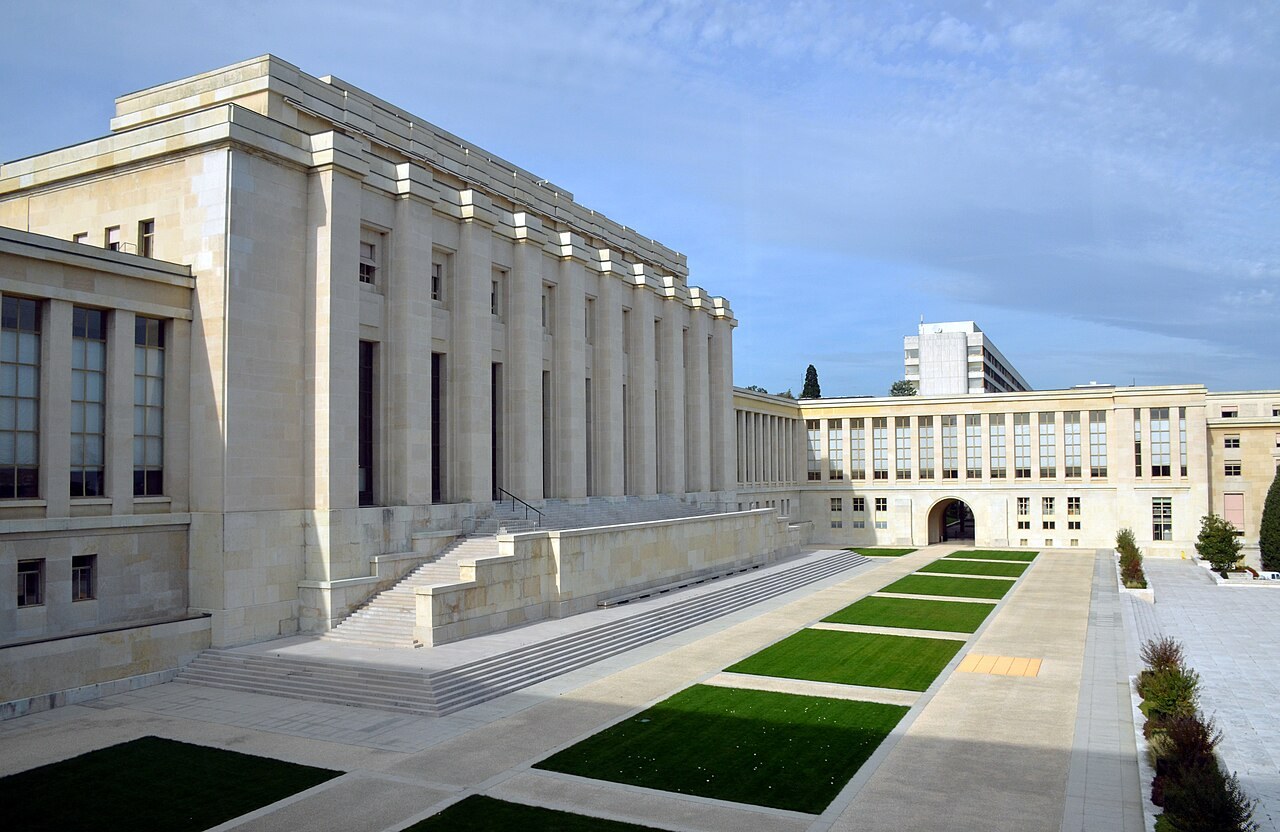
The Palais des Nations, seat of the UN Office at Geneva, the city that hosts the CCW Review Conference of 16-20 November 2026 and in which UNIDIR’s new Centre of Excellence on AI, Peace and Security is anchored. Illustrative.
The United Nations now has a permanent address for arguments about military artificial intelligence. At a press conference on 20 October 2026 the director of the UN Institute for Disarmament Research (UNIDIR), Robin Geiss, said the Institute’s Centre of Excellence on AI, Peace and Security would open an international forum on military uses of AI, the Associated Press reported. The UN Office for Disarmament Affairs’ side-event programme for the General Assembly’s First Committee puts the launch on 22 October, co-hosted with Switzerland and Pakistan. Institution-building is running ahead of law-making, and the one venue that could begin negotiating a binding instrument does not sit until November.
What the new Centre can do, and what it cannot
UNIDIR announced the Centre on 17 June 2026 and anchored it in Geneva on three pillars — knowledge, dialogue and action — whose practical outputs include guidance for national AI and defence strategies. It has no mandate to negotiate anything. Geiss was candid about the ambition in that announcement: “The goal is not a single, unified framework.”
Who pays matters here. The Associated Press reported that Geiss told the press conference the Centre had received funding from the United States, Russia, China, Britain and France, the Security Council’s five permanent members. That rests on a spoken remark relayed by one wire service; no UNIDIR publication this magazine opened repeats it. Geiss also warned, in the same account, that “the margin for human judgment is increasingly narrow, including in the nuclear domain” — the compression of decision time AI & GPP examined in the difference between hour six and hour sixty.
Two drafts in New York, and who is not on them
The First Committee’s eighty-first session runs from 5 October to 6 November 2026. Two texts matter. A/C.1/81/L.37, circulated on 13 October with the 21 sponsors printed on it, calls on the parties to the Convention on Certain Conventional Weapons (CCW) to “advance to negotiations on an instrument” on lethal autonomous weapons systems, building on elements the Convention’s group of governmental experts agreed by consensus. A/C.1/81/L.34, the same date and 47 sponsors, is less ambitious and more durable: it welcomes the Centre, invites states “to consider supporting its work”, and decides on structured dialogues in Geneva, one informal three-day meeting in 2027 and another in 2028, with summaries to the Committee’s next two sessions.
The sponsor lists are the news. As printed on 13 October, France and the United Kingdom back L.34; neither appears on L.37, and China, Russia and the United States sponsor neither. Both texts are non-binding whatever the vote — the division AI & GPP mapped as two blocs and one technology.
| Venue or instrument | What it can actually produce | Who decides | Next dated milestone |
|---|---|---|---|
| UNIDIR Centre of Excellence on AI, Peace and Security (Geneva, announced 17 June 2026) | Research, convening, tools and training; no negotiating mandate | UNIDIR, on voluntary funding | Forum launched 22 October 2026 |
| Framework of Responsible Industry Behaviour for AI in the Military Domain (UNIDIR with the UN human rights office) | Voluntary principles and guidelines for industry, from design and testing to post-deployment support; status “proposed” | UNIDIR and OHCHR, through consultation | No adoption date published |
| First Committee draft A/C.1/81/L.34 (13 October 2026, 47 sponsors) | Non-binding resolution; structured dialogues in Geneva | General Assembly members | Three-day meetings in 2027 and 2028; summaries to the 82nd and 83rd sessions |
| First Committee draft A/C.1/81/L.37 (13 October 2026, 21 sponsors) | Non-binding resolution; a call on CCW parties to negotiate | General Assembly members | Item returns on the 82nd session’s provisional agenda |
| CCW Seventh Review Conference | The only venue on this list that could adopt a negotiating mandate for a binding instrument | The Convention’s high contracting parties | Geneva, 16-20 November 2026 |
| Human Rights Council A/HRC/63/L.25 and L.17 (adopted 7 October 2026 without a vote) | Panels and OHCHR reports | Human Rights Council | Panel at HRC65 and report to HRC66; panel at HRC68 and report to HRC71 |
| Human Rights Council A/HRC/63/L.10 (adopted 7 October 2026) | Practical OHCHR guidance on AI in public administration | Human Rights Council | Report to HRC69 |
The one venue that could open a negotiation
That is the CCW’s Seventh Review Conference, in Geneva from 16 to 20 November 2026. The Council of the European Union approved conclusions on it on 12 October, issued the next day, which look to the conference to adopt an “ambitious negotiating mandate” for the group of experts and state that “the CCW is the relevant international forum on LAWS”. This magazine set out the arithmetic of that meeting when it was five weeks away; it is now three. Nothing the forum in Geneva or the Committee in New York does meanwhile changes who holds the pen.
Geneva’s other calendar, and the dates on it
A fortnight earlier the Human Rights Council closed its sixty-third session by adopting three AI texts without a vote on 7 October. A/HRC/63/L.25 convenes a panel at the sixty-fifth session on putting human rights at the centre of AI and requires a report for the sixty-sixth, informed by consultations including at the margins of the Second Global Dialogue on AI Governance in May 2027. A/HRC/63/L.17 gives the sixty-eighth session’s annual panel to women and girls in digital technologies. A/HRC/63/L.10 is the one a public-sector reader should diarise: it asks the UN human rights office for practical guidance on how public administrations procure, deploy and use AI, reporting to the sixty-ninth session.
The lever that exists now is procurement
UNIDIR says so itself. A commentary published on 22 October argues that military procurement is a direct mechanism for implementing legal obligations: governments can write responsible-AI expectations into contracts and export controls, demand the documentation and system logs accountability needs, and treat reviews of new weapons under Article 36 of Additional Protocol I as iterative, because the systems keep changing after delivery. The companion Framework of Responsible Industry Behaviour for AI in the Military Domain, run in partnership with the UN human rights office, is still marked proposed; named contributors include Microsoft, Hitachi America and the Japan Defense Technology Foundation, and UNIDIR notes others declined to be named.
Nothing agreed in Geneva or New York this month places an obligation on a supplier; a contract clause does, and it is available now. Before 16 November, a defence ministry and a benefits agency need the same three answers: which AI systems are already in service, what documentation the contract entitles the state to see, and who reviews a system again after it is updated.
Sources
- New UN initiative will aim to tackle the military uses of AI — Associated Press (Edith M. Lederer), via Boston 25 News, 20 October 2026
- A new home for AI governance — UNIDIR, 17 June 2026
- General Assembly First Committee, eighty-first session (2026) — UN Office for Disarmament Affairs, October 2026
- A/C.1/81/L.37, “Lethal autonomous weapons systems: draft resolution” — United Nations General Assembly, First Committee, 13 October 2026 (PDF)
- A/C.1/81/L.34, “Artificial intelligence in the military domain and its implications for international peace and security: draft resolution” — United Nations General Assembly, First Committee, 13 October 2026 (PDF)
- Council conclusions on the Seventh Review Conference of the Convention on Certain Conventional Weapons, document 14436/26 — Council of the European Union, 13 October 2026 (PDF; conclusions approved 12 October 2026)
- Human Rights Council concludes its sixty-third regular session (meeting summary) — UN Office of the High Commissioner for Human Rights, 7 October 2026
- Industry responsibility in developing military AI — UNIDIR, 22 October 2026
- Framework of Responsible Industry Behaviour for AI in the Military Domain — UNIDIR, 2026
Claim ledger (piece 15)
| Claim | Source URL | Publisher | Pub. date | Accessed | Primary/Secondary | Single-source? |
|---|---|---|---|---|---|---|
| Geiss said at a 20 October press conference that the Centre would open an international forum on military AI | https://www.boston25news.com/news/technology/new-un-initiative/INOGQSBP4YZD3I3EV5PK3HWN6U/ | Associated Press via Boston 25 News | 20 Oct 2026 | 25 Oct 2026 | Secondary | Yes for the press conference; launch date corroborated by UNODA |
| Centre received funding from the US, Russia, China, Britain and France | same | Associated Press via Boston 25 News | 20 Oct 2026 | 25 Oct 2026 | Secondary | Yes — spoken remark, one wire |
| Quote: “the margin for human judgment is increasingly narrow, including in the nuclear domain” | same | Associated Press via Boston 25 News | 20 Oct 2026 | 25 Oct 2026 | Secondary | Yes |
| Forum launch 22 October, CR.4, co-hosted by UNIDIR, Switzerland and Pakistan; session runs 5 Oct–6 Nov 2026 | https://meetings.unoda.org/ga-c1/general-assembly-first-committee-eighty-first-session-2026 | UN Office for Disarmament Affairs | Oct 2026 | 25 Oct 2026 | Primary | No |
| Centre announced 17 June 2026, Geneva, three pillars; quote “The goal is not a single, unified framework.” | https://unidir.org/a-new-home-for-ai-governance/ | UNIDIR | 17 Jun 2026 | 25 Oct 2026 | Primary | Yes (institutional self-description) |
| A/C.1/81/L.37 dated 13 Oct 2026, 21 sponsors, calls on CCW parties to “advance to negotiations on an instrument” | https://digitallibrary.un.org/record/4130858/files/A_C.1_81_L.37-EN.pdf | UN General Assembly | 13 Oct 2026 | 25 Oct 2026 | Primary | No |
| A/C.1/81/L.34 dated 13 Oct 2026, 47 sponsors, welcomes the Centre, invites support, decides structured dialogues in Geneva in 2027 and 2028 | https://digitallibrary.un.org/record/4130554/files/A_C.1_81_L.34-EN.pdf | UN General Assembly | 13 Oct 2026 | 25 Oct 2026 | Primary | No |
| France and the UK sponsor L.34 and not L.37; China, Russia and the US sponsor neither | the two PDFs above | UN General Assembly | 13 Oct 2026 | 25 Oct 2026 | Primary | No (read off both cover pages) |
| CCW Seventh Review Conference, Geneva, 16-20 November 2026; “ambitious negotiating mandate”; “the CCW is the relevant international forum on LAWS” | https://data.consilium.europa.eu/doc/document/ST-14436-2026-INIT/en/pdf | Council of the European Union | 13 Oct 2026 | 25 Oct 2026 | Primary | No |
| HRC adopted A/HRC/63/L.25, L.17 and L.10 without a vote on 7 Oct 2026; HRC65 panel, HRC66 report, May 2027 Global Dialogue, HRC68 panel, HRC69 guidance on AI in public administration | https://www.ohchr.org/en/meeting-summaries/2026/10/human-rights-council-concludes-sixty-third-regular-session-after-adopting | OHCHR | 7 Oct 2026 | 25 Oct 2026 | Primary | No |
| Procurement as a direct mechanism; iterative Article 36 reviews; logs and documentation | https://unidir.org/industry-responsibility-in-developing-military-ai/ | UNIDIR | 22 Oct 2026 | 25 Oct 2026 | Primary | Yes (institutional commentary, presented as UNIDIR’s argument) |
| Framework status “proposed”, with OHCHR; contributors Microsoft, Hitachi America, Japan Defense Technology Foundation, others unnamed | https://unidir.org/framework-of-responsible-industry-behaviour-for-ai-in-the-military-domain/ | UNIDIR | 2026 | 25 Oct 2026 | Primary | Yes |
| Image author Vassil, CC0 1.0, taken 20 October 2014 | https://commons.wikimedia.org/wiki/File:Palace_of_Nations_Geneva_20102014_02.jpg | Wikimedia Commons | 1 Nov 2014 (upload) | 25 Oct 2026 | Primary | No |
Discussion
No comments yet. Start the conversation.